
 Wildlife
of India
Heart-spotted Woodpecker
Barbets & Woodpeckers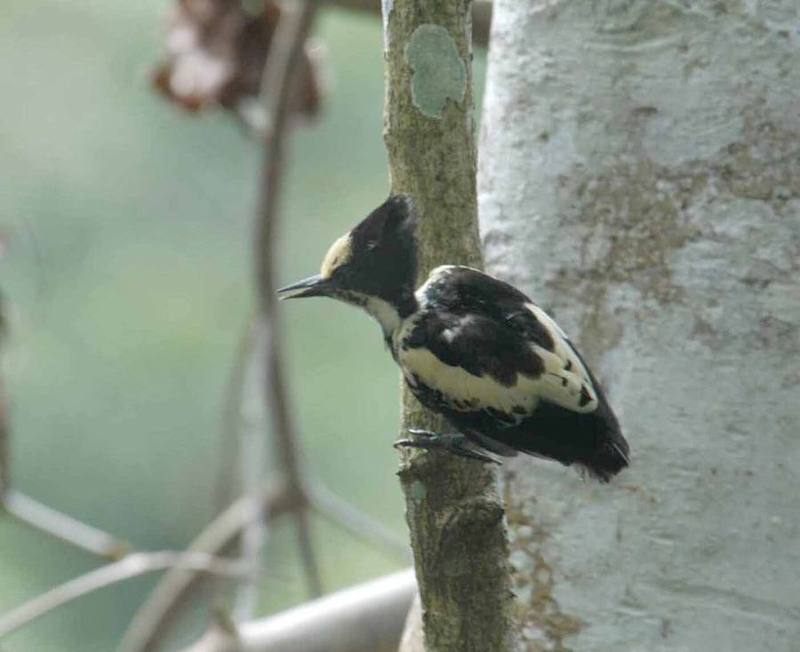
Photo: Blaise Droz www.viensdanslajungle.ch · CC BY-SA 3.0 (May be cropped or resized)
Hemicircus canente
Basic stats
Diet
Mainly insects under bark; larvae from Cassia fistula pods
Habitat
Forest; thin outer branches of trees
Range
Himalayan forests of India, Bangladesh and Southeast Asia; separate populations in south-western and central India, including the Western Ghats
Clutch size
2–3 unmarked white eggs
The heart-spotted woodpecker is a stubby, contrastingly black and white woodpecker with a large wedge-shaped head, a whitish throat and dark olive-grey underparts, easy to identify and easily detected by its frequent calling. It moves about in pairs or small groups and is often found in mixed-species foraging flocks. It forages for invertebrates under the bark of the slender outer branches of trees, and has been known to peck the pods of Cassia fistula to get at insect larvae (Wikipedia, general species account).
It is widely distributed across Asia, with populations in the forests of south-western and central India, including the Western Ghats, slightly separated from those in the Himalaya and Southeast Asia, extending into Bangladesh, Myanmar, Thailand, Laos, Cambodia and Vietnam. The calls include a sharp twee-twee-twee duet, sometimes leading into a trill, a nasal ki-yeew and repeated su-sie calls. The nest is bored in a dead branch, with a narrow 3–4 cm entrance and a tunnel going down about 20 cm before widening into a chamber, and the usual clutch is two or three white eggs. SoIB 2023 rates it a Moderate conservation priority, with a long-term decline of about 55% and a stable current trend (Wikipedia, general species account; SoIB 2023).
Quick answers
- What does the Heart-spotted Woodpecker eat?
- Mainly insects under bark; larvae from Cassia fistula pods
- What habitat does the Heart-spotted Woodpecker live in?
- Forest; thin outer branches of trees
- Where is the Heart-spotted Woodpecker found?
- Himalayan forests of India, Bangladesh and Southeast Asia; separate populations in south-western and central India, including the Western Ghats
- How many eggs does the Heart-spotted Woodpecker lay?
- 2–3 unmarked white eggs