
 Wildlife
of India
Indian Egg-eating Snake
Colubrid Snakes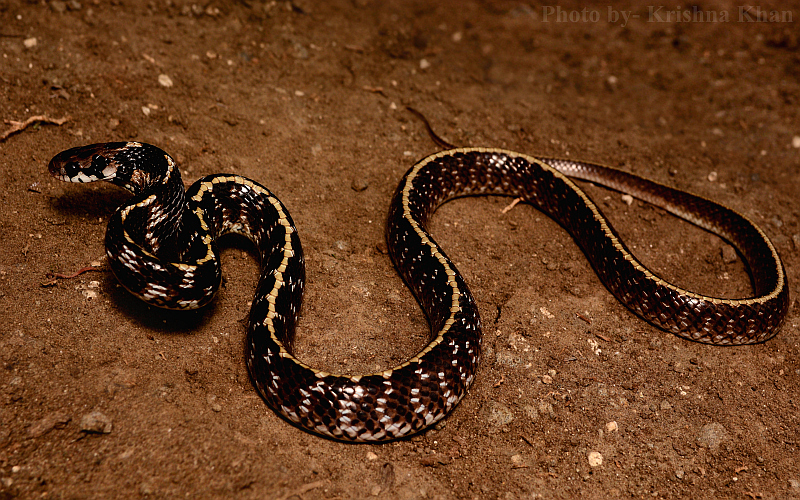
Photo: (c) Ashahar Khan, some rights reserved (CC BY) · CC-BY (May be cropped or resized)
Boiga westermanni
Basic stats
Diet
Bird eggs without embryonic growth
Habitat
Forest and shrubland, 40–1,000m; ground-dwelling but good at scaling vegetation
Range
Bangladesh, India and Nepal
Size
Up to 78cm
The Indian egg-eating snake, also called Westermann's snake, is a rare colubrid endemic to the Indian subcontinent, found in Bangladesh, India and Nepal. It is glossy brown to black, with bluish-white flecks towards the rear and a creamy stripe along the middle of the back from neck to tail tip. The head is brown with a black arrow mark, and the belly is white with brown dots. Adults may reach 78 cm (Wikipedia, general species account).
Its preferred habitats are forest and shrubland at 40–1,000 m. It is active by day or night, lives on the ground and shows remarkable dexterity in scaling vegetation. It feeds exclusively on bird eggs lacking embryonic growth, and the only other snakes with its egg-eating adaptations belong to the African genus Dasypeltis.
Quick answers
- What does the Indian Egg-eating Snake eat?
- Bird eggs without embryonic growth
- What habitat does the Indian Egg-eating Snake live in?
- Forest and shrubland, 40–1,000m; ground-dwelling but good at scaling vegetation
- Where is the Indian Egg-eating Snake found?
- Bangladesh, India and Nepal
- How big is the Indian Egg-eating Snake?
- Up to 78cm