
 Wildlife
of India
Malabar Barbet
Barbets & Woodpeckers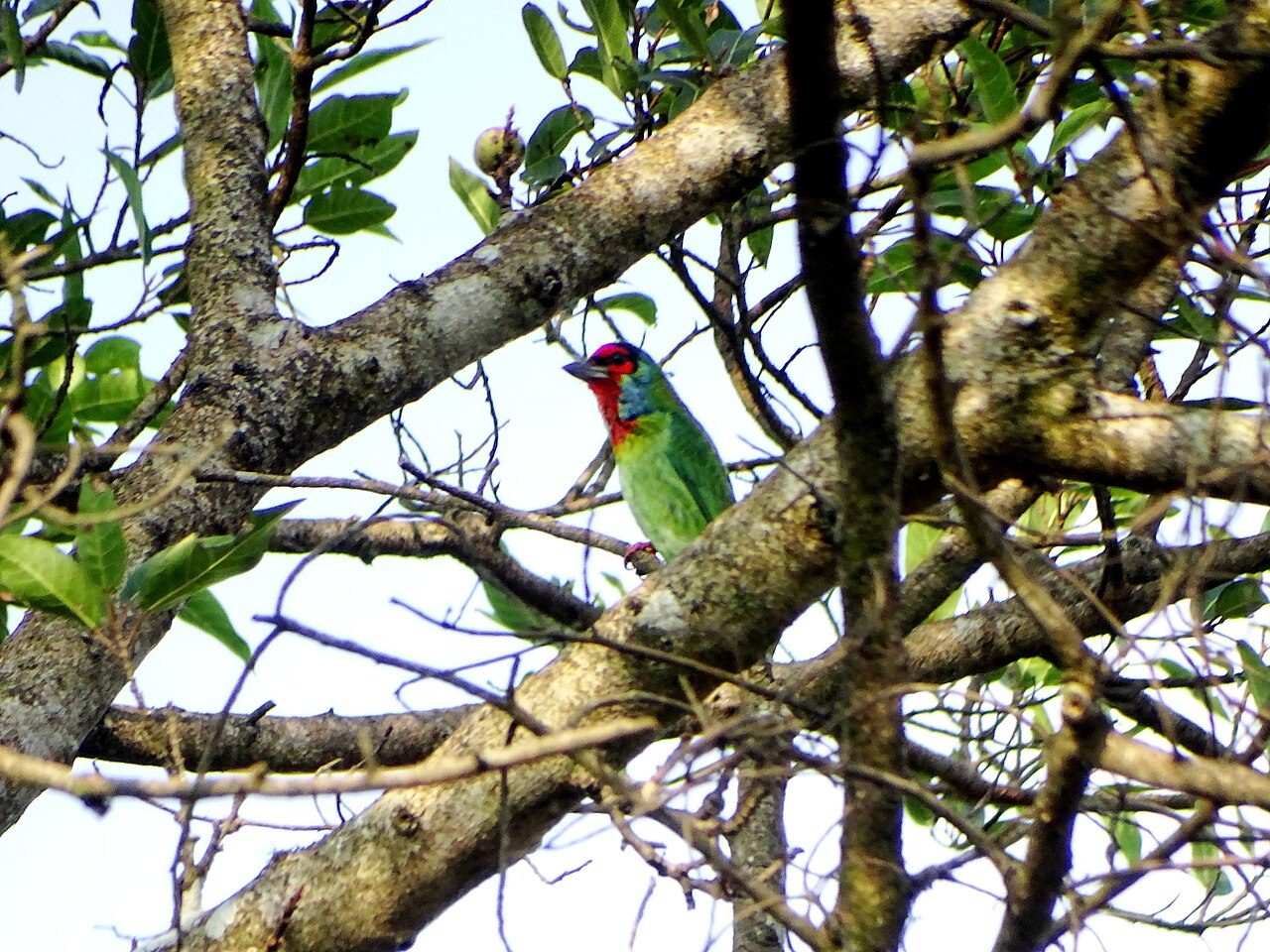
Photo: Forestowlet · CC0
Psilopogon malabaricus
Basic stats
Diet
Fruit, chiefly figs (Ficus retusa, F. gibbosa, F. tsiela in Kerala)
Habitat
Moist evergreen forest, mainly below 1,200m
Range
Endemic to the Western Ghats from around Goa to southern Kerala
Clutch size
2 eggs
Incubation period
14–15 days
The Malabar barbet is an Asian barbet native to the Western Ghats, from around Goa south to southern Kerala, in moist evergreen forest mainly below 1,200 m. It was formerly treated as a race of the crimson-fronted barbet. Its flight is straight and rapid and can resemble that of a lorikeet. It overlaps in places with the coppersmith barbet and has a similar but more rapidly delivered call. In Kerala the fruiting trees it uses are limited mainly to figs, especially Ficus retusa, F. gibbosa and F. tsiela (Wikipedia, general species account).
Birds are usually in pairs in the breeding season, mainly February–March before the rains, and gregarious in the non-breeding season, and a new nest is made each year. It takes about 18 days to excavate the nest; two eggs are laid and incubated for 14–15 days, and the chicks fledge in about 35 days. Palm squirrels may eat the eggs, and the adults chase them off and remove unhatched eggs. SoIB 2023 treats it as a Western Ghats endemic and rates it a Low conservation priority, with a Moderate range of about 90,000 km² (Wikipedia, general species account; SoIB 2023).
Quick answers
- What does the Malabar Barbet eat?
- Fruit, chiefly figs (Ficus retusa, F. gibbosa, F. tsiela in Kerala)
- What habitat does the Malabar Barbet live in?
- Moist evergreen forest, mainly below 1,200m
- Where is the Malabar Barbet found?
- Endemic to the Western Ghats from around Goa to southern Kerala
- How many eggs does the Malabar Barbet lay?
- 2 eggs
- How long are the eggs of the Malabar Barbet incubated?
- 14–15 days