
 Wildlife
of India
Malabar Spiny Tree Mouse
Rats, Mice, Voles & Porcupines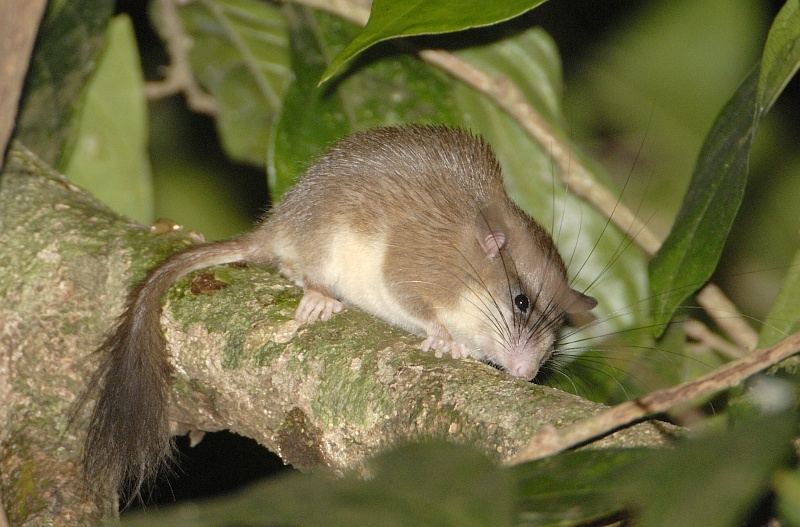
Photo: Kalyanvarma · CC BY-SA 3.0 (May be cropped or resized)
Platacanthomys lasiurus
Basic stats
Diet
Largely fruit
Habitat
Denser forest of the Western Ghats and Nilgiri hills, up to about 2,000m; tree holes
Range
Endemic to the Western Ghats of India
Litter size
4 young noted in one litter
Size
About 13cm long; tail about 10cm
The Malabar spiny dormouse is the only living species in its genus and, although it looks like a dormouse, is not closely related to dormice. It is about the size of a brown rat, about 13 cm long with a tail of about 10 cm, brownish above and whitish below with a distinct border. It has spiny fur on the back, large ears pointed at the tip, and a bushy tuft at the tail tip, the hairs arising from the sides of the tail so that it looks slightly flattened (Wikipedia, general species account).
It is endemic to the Western Ghats of India, found only in the denser forest regions of the Western Ghats and Nilgiri hills, up to about 2,000 m, at very low densities. The northernmost record is from Sagar in Shimoga district of Karnataka. It is arboreal and nocturnal, living in tree holes in a small family group, and largely eats fruit. It was considered a minor pest of fruit trees and of cardamom and pepper plantations, though surveys suggest it stays mainly in undisturbed forest (Wikipedia, general species account).
Quick answers
- What does the Malabar Spiny Tree Mouse eat?
- Largely fruit
- What habitat does the Malabar Spiny Tree Mouse live in?
- Denser forest of the Western Ghats and Nilgiri hills, up to about 2,000m; tree holes
- Where is the Malabar Spiny Tree Mouse found?
- Endemic to the Western Ghats of India
- What is the litter size of the Malabar Spiny Tree Mouse?
- 4 young noted in one litter
- How big is the Malabar Spiny Tree Mouse?
- About 13cm long; tail about 10cm