
 Wildlife
of India
Northern King Cobra
Cobras, Kraits & Sea Snakes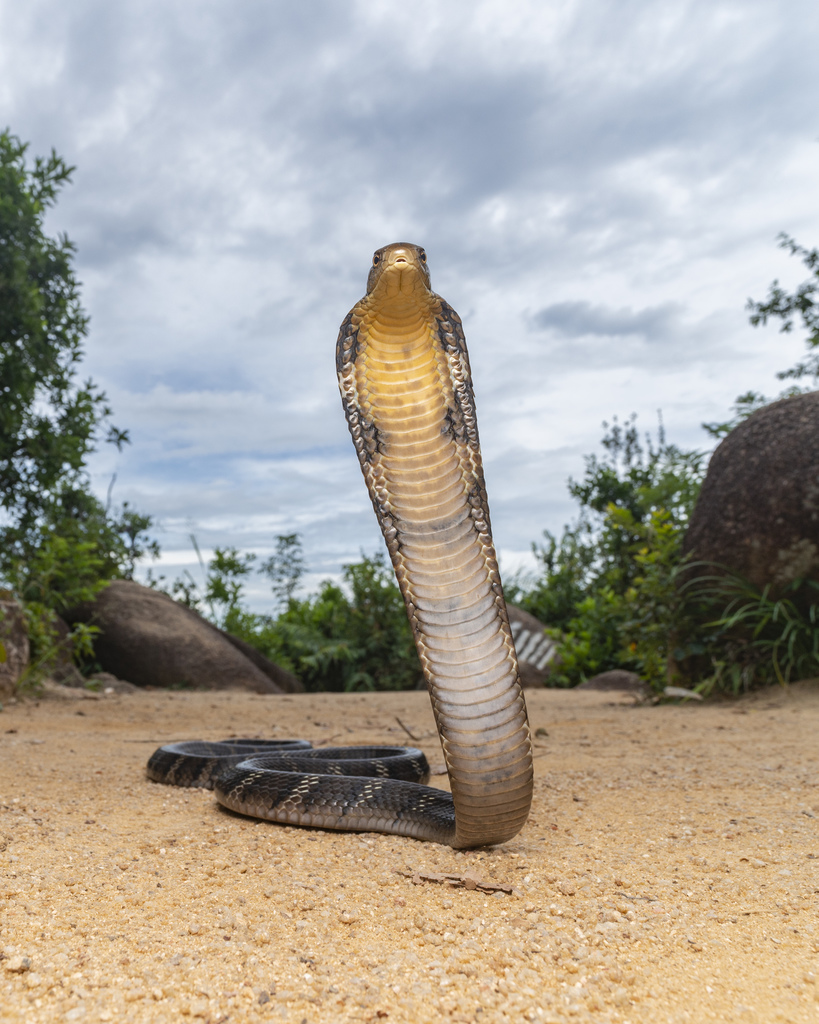
Photo: Lawrence Hylton · CC-BY (May be cropped or resized)
Ophiophagus hannah
Basic stats
Diet
Mainly other snakes, including cobras, kraits, rat snakes and pythons; also monitor lizards
Habitat
Forest, up to about 2,000m
Range
Northern and eastern India and the Andaman Islands (not the Western Ghats)
Size
Adults usually 3.2–4m; record 5.85m
The king cobra is the world's longest venomous snake; since 2024 it has been treated as four species, and this is the northern one. Adults are olive green with black and white bands on the body that converge towards the head, a black tongue, a rounded snout and large, drab, black-edged shields on the crown, including a pair of big scales at the back of the head. Juveniles are black with white, yellow or buff chevrons pointing towards the head. Males are larger than females and paler in the breeding season. When alarmed it raises the front of its body, spreads its hood, shows its fangs and gives a deep hiss that sounds more like a growl (Wikipedia, general species account).
The king cobra feeds mainly on other snakes, including rat snakes, kraits, Indian cobras and even pythons, and on monitor lizards. It hunts mostly by day, picking up the scent of prey with its forked tongue, and swallows it whole. It is the only snake that builds an above-ground nest for its eggs, which the female gathers carefully and guards throughout incubation, when she will defend it fiercely. Away from the nest it is not considered aggressive and usually slips away from people (Wikipedia, general species account).
A 2024 revision split the king cobra into four species, two of them in India. The northern king cobra (Ophiophagus hannah) is the widespread one, found in northern and eastern India and the Andaman Islands and on eastwards through Indochina; the king cobras of the Western Ghats are now a separate species, O. kaalinga. Northern snakes have 40–70 pale bands, and the white scales in each band have black borders (Gowri Shankar et al. 2024, as reported by Mongabay India). Most of what is written about king cobra behaviour was learned before the split, so it may apply to more than one of the species.
Quick answers
- What does the Northern King Cobra eat?
- Mainly other snakes, including cobras, kraits, rat snakes and pythons; also monitor lizards
- What habitat does the Northern King Cobra live in?
- Forest, up to about 2,000m
- Where is the Northern King Cobra found?
- Northern and eastern India and the Andaman Islands (not the Western Ghats)
- How big is the Northern King Cobra?
- Adults usually 3.2–4m; record 5.85m