
 Wildlife
of India
Rufous Babbler
Babblers, Laughingthrushes & White-eyes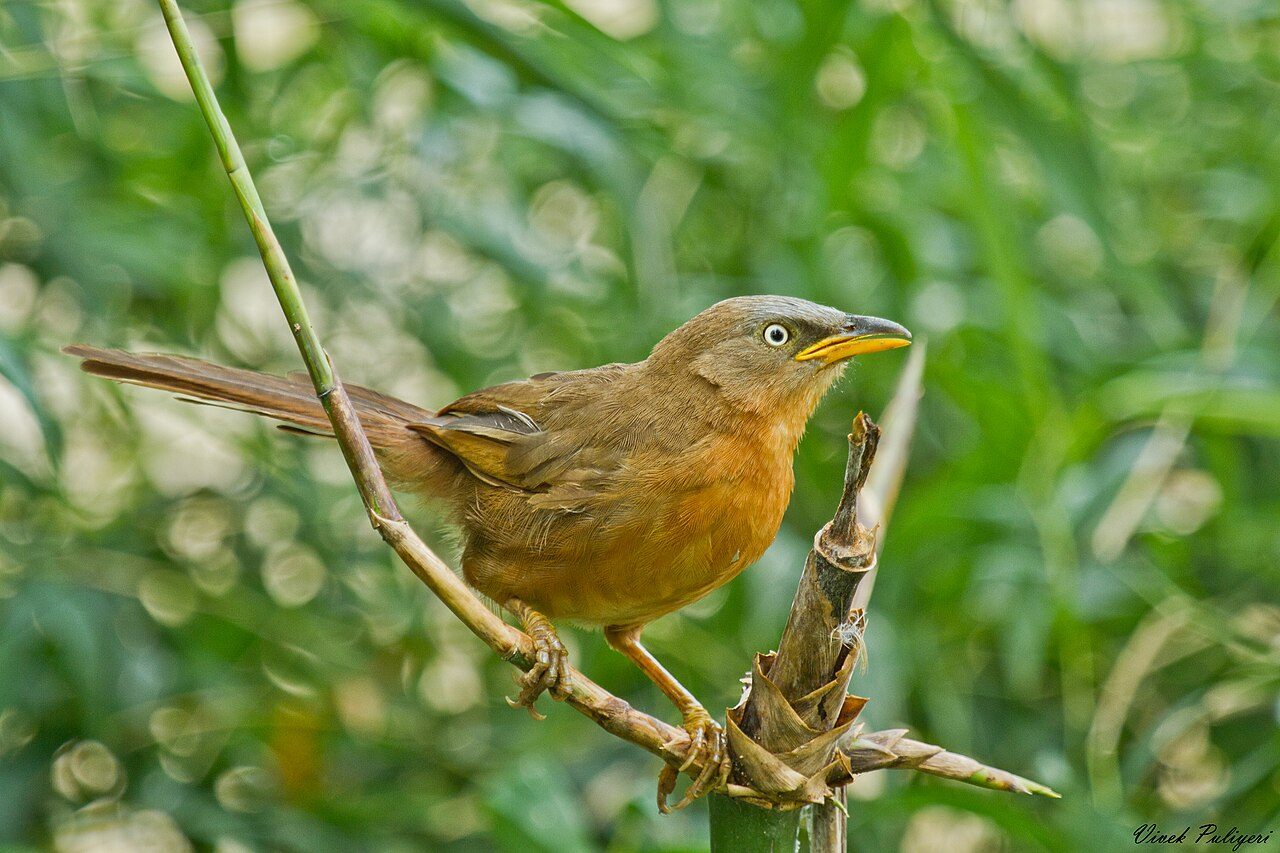
Photo: Vivek Puliyeri · CC BY-SA 4.0 (May be cropped or resized)
Argya subrufa
Basic stats
Diet
Insects and berries, mainly near the ground
Habitat
Open hillsides with a mixture of grass, bracken and forest; nest a small cup in the fork of a tree
Range
Endemic to the Western Ghats south of Mahabaleshwar to the Palni hills, and east into the Shevaroy hills
Clutch size
2–4 dark glossy blue eggs, usually 3
Size
25–26cm; tail about 11–11.5cm
The rufous babbler is a large, dark, long-tailed babbler endemic to the Western Ghats, 25–26 cm long, usually seen foraging in noisy groups along open hillsides with a mixture of grass, bracken and forest. It is dark olive-brown above with a grey forehead whose feathers have black shafts, a pale white to yellow iris and dark lores. It is found south of Mahabaleshwar to the Palni hills and east into the Shevaroy hills; the nominate form is north of the Palghat Gap and hyperythra to the south is said to be more richly coloured (Wikipedia, general species account).
It is found mainly close to the ground, feeding on insects and berries but also using trees. The breeding season is mainly February to November, in a small cup nest in the fork of a tree, with two to four, usually three, dark glossy blue eggs. It has a loud ringing treenh-treenh call. SoIB 2023 treats it as a Western Ghats endemic and rates it a Moderate conservation priority, with a Moderate range of about 108,000 km² and a decline of about 50% over the long term (Wikipedia, general species account; SoIB 2023).
Quick answers
- What does the Rufous Babbler eat?
- Insects and berries, mainly near the ground
- What habitat does the Rufous Babbler live in?
- Open hillsides with a mixture of grass, bracken and forest; nest a small cup in the fork of a tree
- Where is the Rufous Babbler found?
- Endemic to the Western Ghats south of Mahabaleshwar to the Palni hills, and east into the Shevaroy hills
- How many eggs does the Rufous Babbler lay?
- 2–4 dark glossy blue eggs, usually 3
- How big is the Rufous Babbler?
- 25–26cm; tail about 11–11.5cm