
 Wildlife
of India
Tibetan Blackbird
Thrushes, Chats & Flycatchers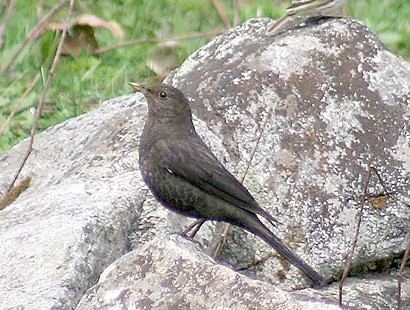
Photo: Jimfbleak at English Wikipedia · CC BY-SA 3.0 (May be cropped or resized)
Turdus maximus
Basic stats
Diet
Earthworms, molluscs, insects, small lizards, fruit and seeds
Habitat
3,200–4,800m, descending in winter but seldom below 3,000m; mud, hair and fine-grass cup nest
Range
Himalaya from northern Pakistan to south-eastern Tibet: India, Pakistan, Nepal, Bhutan and China
Clutch size
3–4 eggs
Size
23–28cm
The Tibetan blackbird is a relatively large thrush, 23–28 cm long. It was described as a separate species by Henry Seebohm in 1881, then considered a subspecies of the common blackbird until 2008, when phylogenetic evidence showed it was only distantly related. It differs from the common blackbird in its complete lack of an eye ring and in its reduced song, without warbles or trills. It is found in the Himalaya from northern Pakistan to south-eastern Tibet, locally in India, Pakistan, Nepal, Bhutan and China (Wikipedia, general species account).
It is usually found at 3,200–4,800 m and descends to lower elevations in winter but seldom below 3,000 m. It is omnivorous, feeding on earthworms, molluscs, insects, small lizards, fruit and seeds. Cup nests are made of mud, animal hair and fine grass with clutches of three or four eggs, and breeding is from May to July, peaking from June to early July. SoIB 2023 treats it as a Himalayan endemic and rates it a High conservation priority, a winter migrant and localised summer migrant of alpine and cold desert with a Very Restricted range of about 3,020 km² (Wikipedia, general species account; SoIB 2023).
Quick answers
- What does the Tibetan Blackbird eat?
- Earthworms, molluscs, insects, small lizards, fruit and seeds
- What habitat does the Tibetan Blackbird live in?
- 3,200–4,800m, descending in winter but seldom below 3,000m; mud, hair and fine-grass cup nest
- Where is the Tibetan Blackbird found?
- Himalaya from northern Pakistan to south-eastern Tibet: India, Pakistan, Nepal, Bhutan and China
- How many eggs does the Tibetan Blackbird lay?
- 3–4 eggs
- How big is the Tibetan Blackbird?
- 23–28cm