
 Wildlife
of India
Andaman Shama
Thrushes, Chats & Flycatchers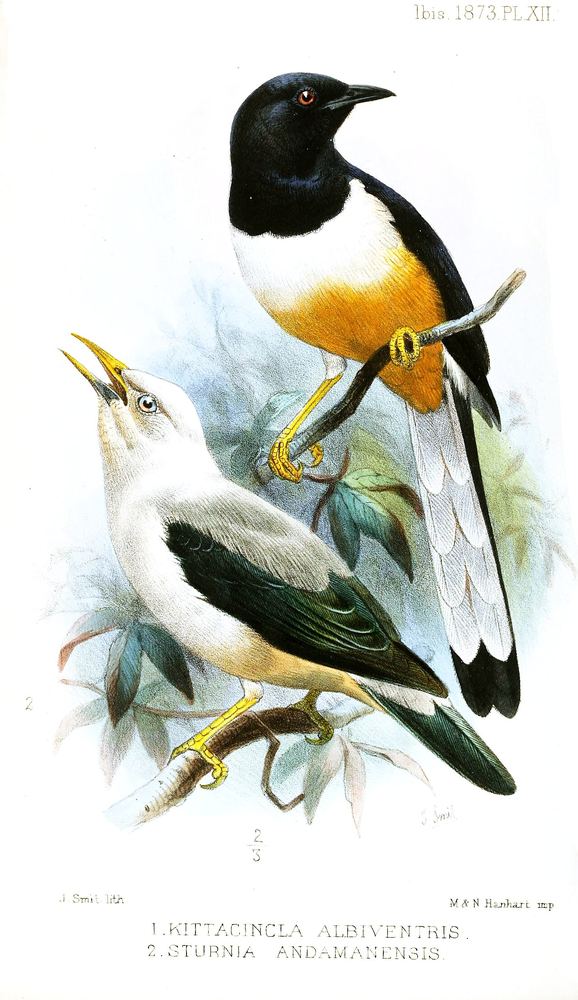
Photo: Joseph Smit · Public domain
Copsychus albiventris
Basic stats
Habitat
Forested and semi-open habitats across several Andaman islands; not recorded on islands smaller than about 3.6 km²; nests of grass and dry bamboo leaves lined with roots, twigs and rhizomorphs
Range
Endemic to the Andaman Islands
Clutch size
2–3 greenish eggs marked with purple-brown or grey spotting
The Andaman shama is a small thrush-shaped bird of the Old World flycatcher family, endemic to the Andaman Islands, and was previously considered a subspecies of the white-rumped shama. The sexes are generally similar, though females typically show slightly duller colour around the chin and throat; the underparts are white with slightly reddish flanks, the upperparts range from pale orange to warm brown, and the central tail feathers are black and extend slightly beyond the white outer tail feathers. Males have tails of about 117–122 mm, females about 98–106 mm (Wikipedia, general species account).
It inhabits forested and semi-open habitats across several islands of the archipelago and is sedentary, and has not been recorded on islands smaller than about 3.6 km². Published information on its behaviour is limited and its diet remains poorly documented. Breeding is typically late May to late June, in nests of grass and dry bamboo leaves lined with softer materials such as roots, twigs and rhizomorphs, with two to three greenish eggs. SoIB 2023 treats it as an Andaman endemic and rates it a Moderate conservation priority, with a Restricted range of about 5,030 km² (Wikipedia, general species account; SoIB 2023).
Quick answers
- What habitat does the Andaman Shama live in?
- Forested and semi-open habitats across several Andaman islands; not recorded on islands smaller than about 3.6 km²; nests of grass and dry bamboo leaves lined with roots, twigs and rhizomorphs
- Where is the Andaman Shama found?
- Endemic to the Andaman Islands
- How many eggs does the Andaman Shama lay?
- 2–3 greenish eggs marked with purple-brown or grey spotting