
 Wildlife
of India
Black-backed Forktail
Thrushes, Chats & Flycatchers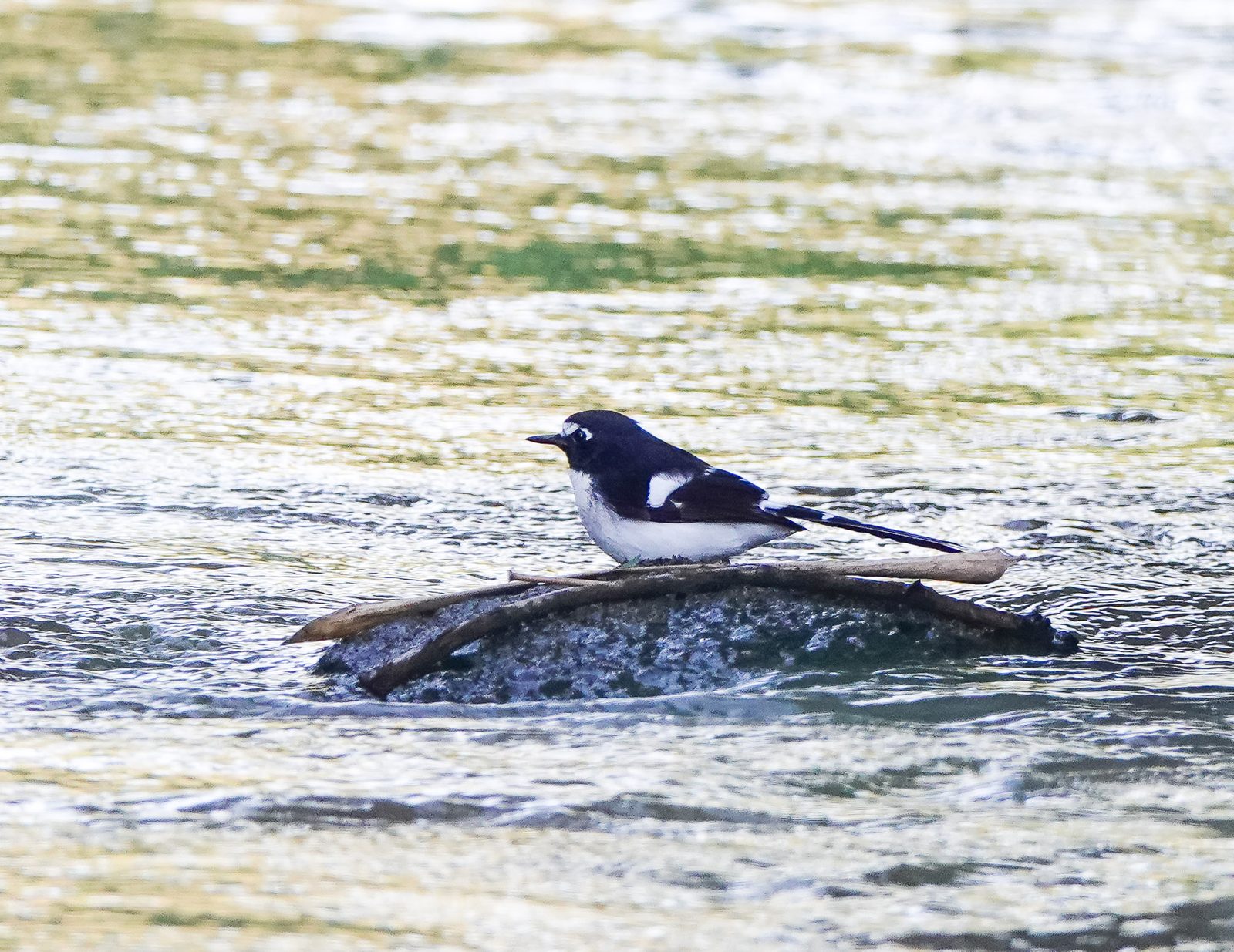
Photo: (c) Rejoice Gassah, some rights reserved (CC BY) · CC-BY (May be cropped or resized)
Enicurus immaculatus
Basic stats
Diet
Invertebrates (SoIB guild)
Habitat
Forest streams; nest of plant matter in holes or crevices in rocks and dead trees
Range
Indian subcontinent and adjoining Southeast Asia: Bangladesh, Bhutan, India, Myanmar, Nepal and Thailand; western limit in Garhwal, Uttarakhand
Clutch size
Usually 3 pink eggs, sparsely specked red-brown
The black-backed forktail, occasionally called the black-throated forktail, is a monomorphic forktail with a broad white stripe across the forehead. The crown, face and mantle are black, sharply divided from the white underparts; the wings are largely black with a broad white stripe across the greater coverts, and the tail black with a white tip and three white bands made by shorter tail feathers. It is found across Bangladesh, Bhutan, India, Myanmar, Nepal and Thailand, its western end in Garhwal in the north-west of Uttarakhand; it is known as a winter visitor to Nameri National Park in Assam, uncommon west of Sikkim and common in Bhutan (Wikipedia, general species account).
It is solitary, occasionally in pairs or family groups. It breeds between March and June, both sexes building the nest of plant matter in holes or crevices in rocks and dead trees and incubating the usually three pinkish eggs. Its call is a short whistled tseep-dew or hurt-zeee, with a two-syllable call when disturbed and occasionally a short song. SoIB 2023 rates it a Low conservation priority, a resident forest bird with a Moderate range of about 81,600 km² and inconclusive trends (Wikipedia, general species account; SoIB 2023).
Quick answers
- What does the Black-backed Forktail eat?
- Invertebrates (SoIB guild)
- What habitat does the Black-backed Forktail live in?
- Forest streams; nest of plant matter in holes or crevices in rocks and dead trees
- Where is the Black-backed Forktail found?
- Indian subcontinent and adjoining Southeast Asia: Bangladesh, Bhutan, India, Myanmar, Nepal and Thailand; western limit in Garhwal, Uttarakhand
- How many eggs does the Black-backed Forktail lay?
- Usually 3 pink eggs, sparsely specked red-brown