
 Wildlife
of India
Boulenger's Bronzeback
Colubrid Snakes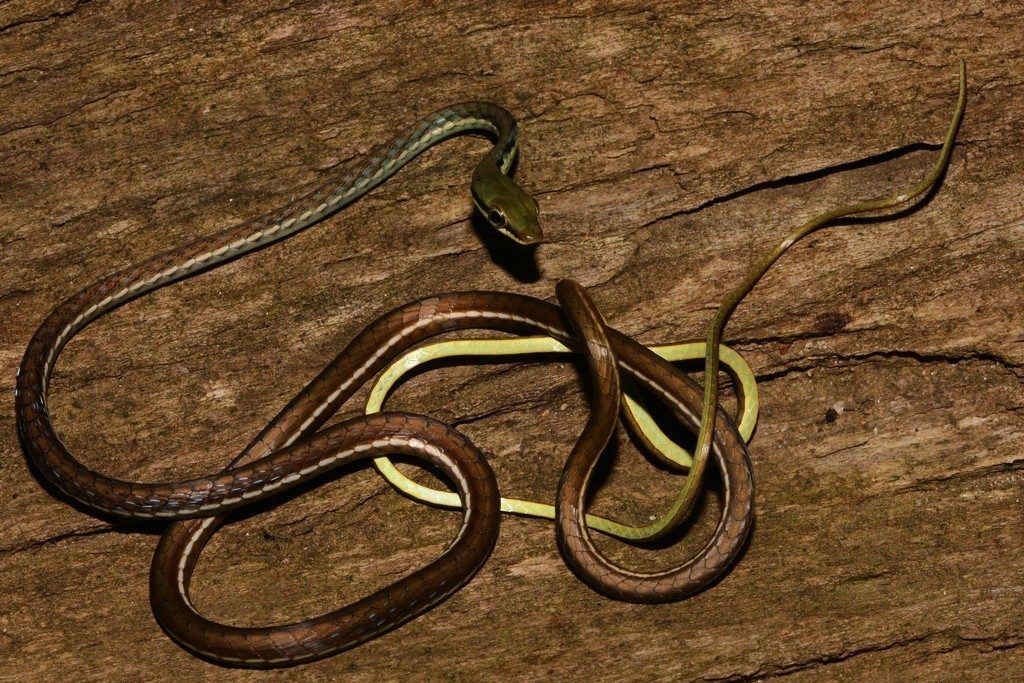
Photo: Ruchira Somaweera, H.K. Dushantha Kandambi, Imesh Nuwan Bandara and Others · Public Domain
Dendrelaphis bifrenalis
Basic stats
Diet
Frogs, geckos, skinks and agamid lizards
Habitat
Trees, shrubs and bushes; arboreal and active by day
Range
Eastern Ghats of southern India and Sri Lanka
Clutch size
5 long eggs, laid in tree hollows
Size
700–900mm
Boulenger's bronzeback, also called the Travancore bronze-brown snake, is a colubrid native to the Eastern Ghats of southern India and to Sri Lanka, first described by George Albert Boulenger in 1890. The body is cylindrical, narrow and slender, the head pear-shaped and flattened, the tail prehensile and a third of the body length, and the back is copper-coloured (Wikipedia, general species account).
It is active by day and lives in trees, shrubs and bushes, feeding on frogs, geckos, skinks and agamid lizards, and sometimes descends to the ground. It lays about five long eggs at a time in tree hollows. Adults grow to about 700–900 mm. The Reptile Database lists Tamil Nadu in India.
Quick answers
- What does the Boulenger's Bronzeback eat?
- Frogs, geckos, skinks and agamid lizards
- What habitat does the Boulenger's Bronzeback live in?
- Trees, shrubs and bushes; arboreal and active by day
- Where is the Boulenger's Bronzeback found?
- Eastern Ghats of southern India and Sri Lanka
- How many eggs does the Boulenger's Bronzeback lay?
- 5 long eggs, laid in tree hollows
- How big is the Boulenger's Bronzeback?
- 700–900mm