
 Wildlife
of India
Bugun Liocichla
Babblers, Laughingthrushes & White-eyes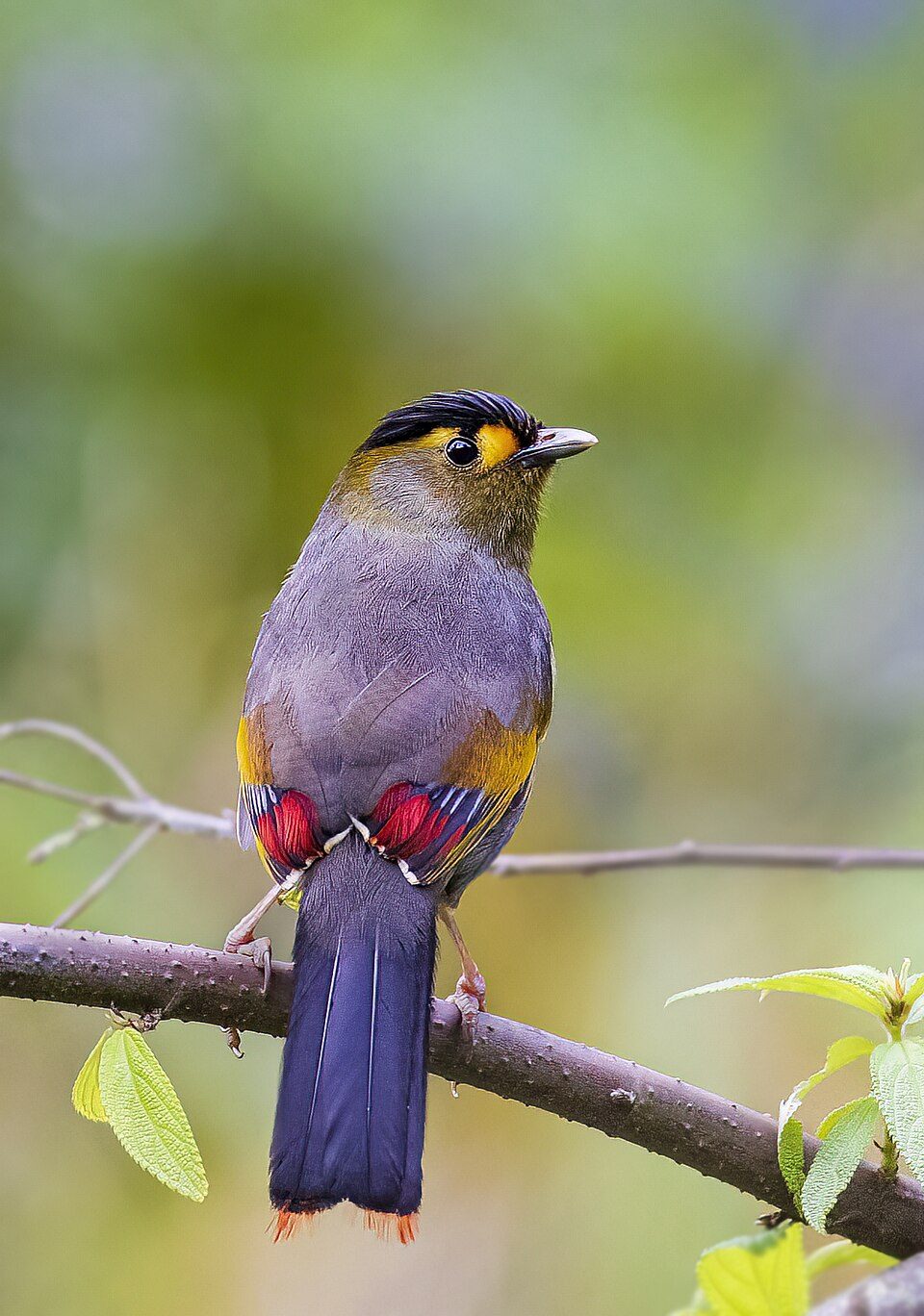
Photo: Muk.Seh · CC BY-SA 4.0 (May be cropped or resized)
Liocichla bugunorum
Basic stats
Diet
Omnivore (SoIB guild)
Habitat
Disturbed hillsides covered with shrubs and small trees at about 2,000m, with one sighting at the edge of primary forest
Range
Endemic to Arunachal Pradesh, India, first found in Eaglenest Wildlife Sanctuary
Size
20cm
The Bugun liocichla is a small laughingthrush, 20 cm long, with olive-grey plumage and a black cap, closely related to the Emei Shan liocichla. The face is marked with prominent orange-yellow lores, the wings have yellow, red and white patches, the tail is black with crimson undertail coverts and red tips, the feet are pink and the bill is black at the face fading to pale white. It was first spotted in 1995 in Arunachal Pradesh but not seen again for ten years, and was described as a new species in 2006 after being discovered in Eaglenest Wildlife Sanctuary by an astrophysicist, Ramana Athreya (Wikipedia, general species account).
All sightings have been at about 2,000 m on disturbed hillsides covered with shrubs and small trees, with one exception at the edge of primary forest. Populations may be discovered elsewhere in Arunachal Pradesh or neighbouring Bhutan. SoIB 2023 treats it as an Eastern Himalayan endemic and rates it a High conservation priority, a resident forest bird and omnivore with a Very Restricted range of about 1,630 km² (Wikipedia, general species account; SoIB 2023).
Quick answers
- What does the Bugun Liocichla eat?
- Omnivore (SoIB guild)
- What habitat does the Bugun Liocichla live in?
- Disturbed hillsides covered with shrubs and small trees at about 2,000m, with one sighting at the edge of primary forest
- Where is the Bugun Liocichla found?
- Endemic to Arunachal Pradesh, India, first found in Eaglenest Wildlife Sanctuary
- How big is the Bugun Liocichla?
- 20cm