
 Wildlife
of India
Burmese Python
Pythons & Sand Boas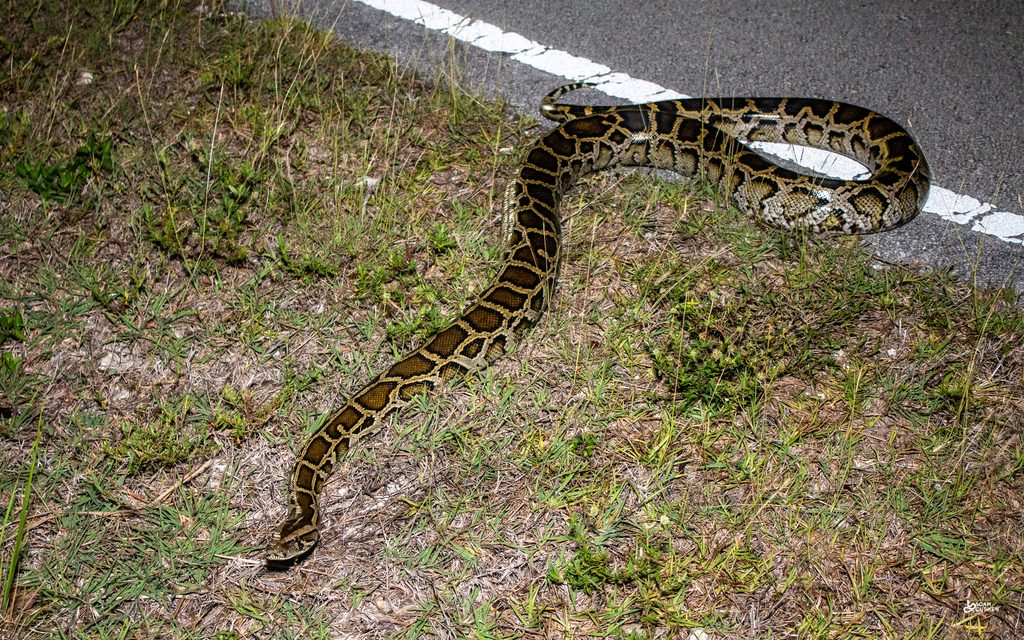
Photo: (c) Adam Cushen, some rights reserved (CC BY) · CC-BY (May be cropped or resized)
Python bivittatus
Basic stats
Habitat
Mainly rainforest, with a permanent water source
Range
North-east India (Assam, Tripura, Sikkim, Meghalaya, Mizoram, Arunachal Pradesh, Nagaland and others), Nepal, Bhutan, Bangladesh and South-east Asia to southern China
Size
Typically up to 5m; over 7m unconfirmed; adults at least 2.35m
The Burmese python is one of the largest snakes in the world. It is a dark, non-venomous snake with many brown blotches bordered by black down the back. It can swim and climb thanks to its prehensile tail and needs a permanent source of water. In the wild it typically grows to 5 m, and individuals over 5 m are rare, while specimens over 7 m are unconfirmed (Wikipedia, general species account).
Until 2009 it was considered a subspecies of the Indian python. A genetic study in 2018 found that the python population is composed of hybrids between the Burmese python and the Indian python. Burmese pythons are mainly nocturnal rainforest dwellers. It is an invasive species in Florida as a result of the pet trade. The Reptile Database lists Assam, Tripura, Sikkim, Meghalaya, Mizoram, Arunachal Pradesh, Uttar Pradesh and Nagaland in India.
Quick answers
- What habitat does the Burmese Python live in?
- Mainly rainforest, with a permanent water source
- Where is the Burmese Python found?
- North-east India (Assam, Tripura, Sikkim, Meghalaya, Mizoram, Arunachal Pradesh, Nagaland and others), Nepal, Bhutan, Bangladesh and South-east Asia to southern China
- How big is the Burmese Python?
- Typically up to 5m; over 7m unconfirmed; adults at least 2.35m