
 Wildlife
of India
Green Avadavat
Finches, Sparrows & Buntings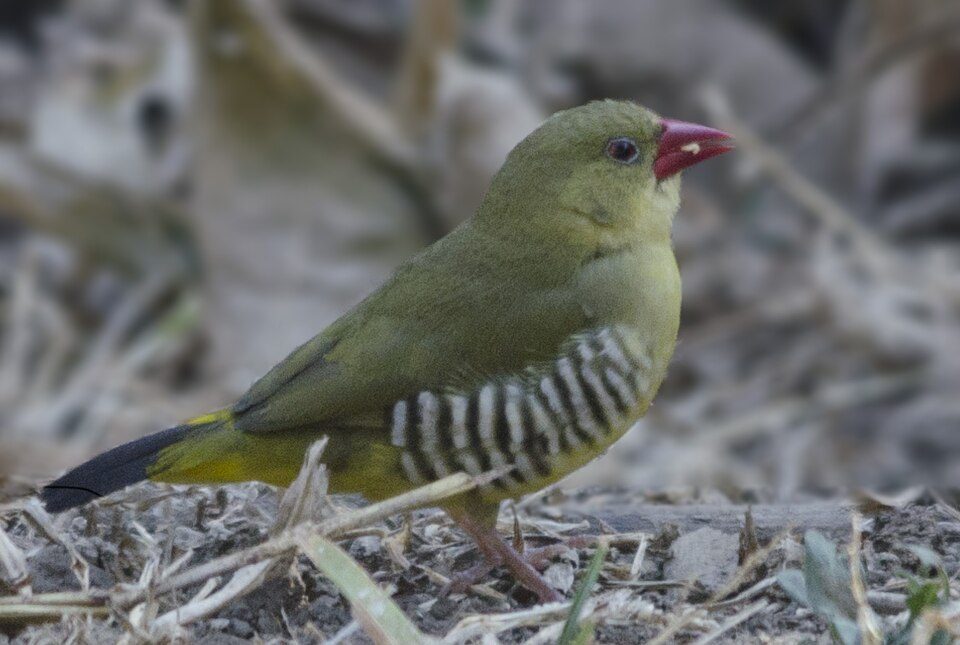
Photo: Pkspks · CC BY-SA 3.0 (May be cropped or resized)
Amandava formosa
Basic stats
Diet
Plants and seeds (SoIB guild); forages in small groups
Habitat
Grassland and scrub; spherical nest of broad grass or sugarcane leaves with a side entrance, in loose colonies
Range
Endemic to the Indian subcontinent; largest populations in central and north-western India; some records from Wynaad in northern Kerala, of uncertain origin
Clutch size
4–6 eggs
Size
About 10cm
The green avadavat, or green munia, is an estrildid finch about 10 cm long, green above and yellow below, with a waxy red bill and black-and-white zebra stripes on the flanks. The upper plumage is olive green, the upper tail coverts more yellow, the tail black and rounded, the chin pale yellow and the lower breast, belly and vent brighter yellow, the flanks barred brown and white. Young birds are duller with a black bill and lack the flank barring. It is endemic to the Indian subcontinent and was formerly popular as a cage bird; the name avadavat is a corruption of the city of Ahmedabad in Gujarat, a centre of the bird trade (Wikipedia, general species account).
The largest populations are in central and north-western India, with some records from further south, from Wynaad in northern Kerala, though it is unclear whether these are wild populations. It breeds in central India from October to January and is also known to breed in July, in a spherical nest of broad grass or sugarcane leaves with a side entrance; several nests may be built near each other by pairs forming a loose colony, and the clutch is four to six eggs. They forage in small groups, especially in the non-breeding season. SoIB 2023 treats it as a Central India endemic and rates it a High conservation priority, with a Restricted range of about 11,800 km² and insufficient data on trends (Wikipedia, general species account; SoIB 2023).
Quick answers
- What does the Green Avadavat eat?
- Plants and seeds (SoIB guild); forages in small groups
- What habitat does the Green Avadavat live in?
- Grassland and scrub; spherical nest of broad grass or sugarcane leaves with a side entrance, in loose colonies
- Where is the Green Avadavat found?
- Endemic to the Indian subcontinent; largest populations in central and north-western India; some records from Wynaad in northern Kerala, of uncertain origin
- How many eggs does the Green Avadavat lay?
- 4–6 eggs
- How big is the Green Avadavat?
- About 10cm