
 Wildlife
of India
Himalayan Bulbul
Bulbuls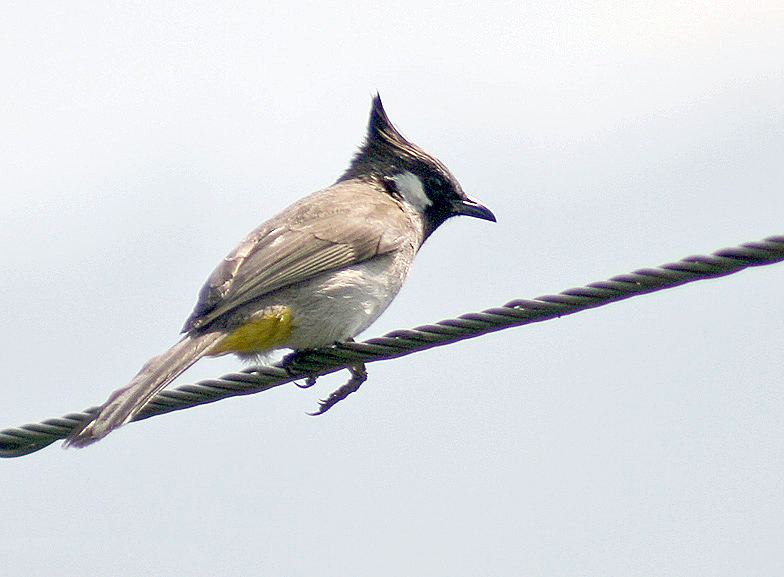
Photo: J.M.Garg · CC BY-SA 3.0 (May be cropped or resized)
Pycnonotus leucogenys
Basic stats
Diet
Insects and other small invertebrates, berries, fruits, seeds, buds and nectar
Habitat
Cup nest in bushes or low branches, of stems, roots and twigs
Range
Northern Indian subcontinent and some adjoining areas, predominantly Kashmir and near the Himalaya
Clutch size
Usually 3 eggs
Incubation period
12 days; chicks leave the nest at 9–11 days
Size
18cm; wingspan 25.5–28cm
Weight
Average 30g
The Himalayan, or white-cheeked, bulbul is about 18 cm long with a wingspan of 25.5–28 cm and an average weight of 30 g. The head, throat and crest are black and white, the back, sides and long tail brown and the underside pale yellow, with the sexes similar. It is found in the northern regions of the Indian subcontinent and some adjoining areas, predominantly in Kashmir and near the Himalaya. Its song is a beautiful four-part whistle like an accelerated oriole whistle (Wikipedia, general species account).
It feeds on insects and other small invertebrates, and on berries, fruits, seeds, buds and nectar. Nests are usually in bushes or on low branches, cup-shaped and made of stems, roots and twigs, and adults become very territorial during breeding. The female usually lays three eggs, incubated for 12 days, and the chicks leave the nest at 9–11 days. SoIB 2023 treats it as a Himalayan endemic and rates it a Low conservation priority, a local migrant with a Moderate range of about 130,000 km² and an increase of about 61% over the long term (Wikipedia, general species account; SoIB 2023).
Quick answers
- What does the Himalayan Bulbul eat?
- Insects and other small invertebrates, berries, fruits, seeds, buds and nectar
- What habitat does the Himalayan Bulbul live in?
- Cup nest in bushes or low branches, of stems, roots and twigs
- Where is the Himalayan Bulbul found?
- Northern Indian subcontinent and some adjoining areas, predominantly Kashmir and near the Himalaya
- How many eggs does the Himalayan Bulbul lay?
- Usually 3 eggs
- How long are the eggs of the Himalayan Bulbul incubated?
- 12 days; chicks leave the nest at 9–11 days
- How big is the Himalayan Bulbul?
- 18cm; wingspan 25.5–28cm
- How much does the Himalayan Bulbul weigh?
- Average 30g