
 Wildlife
of India
Himalayan Musk-deer
Deer & Chevrotains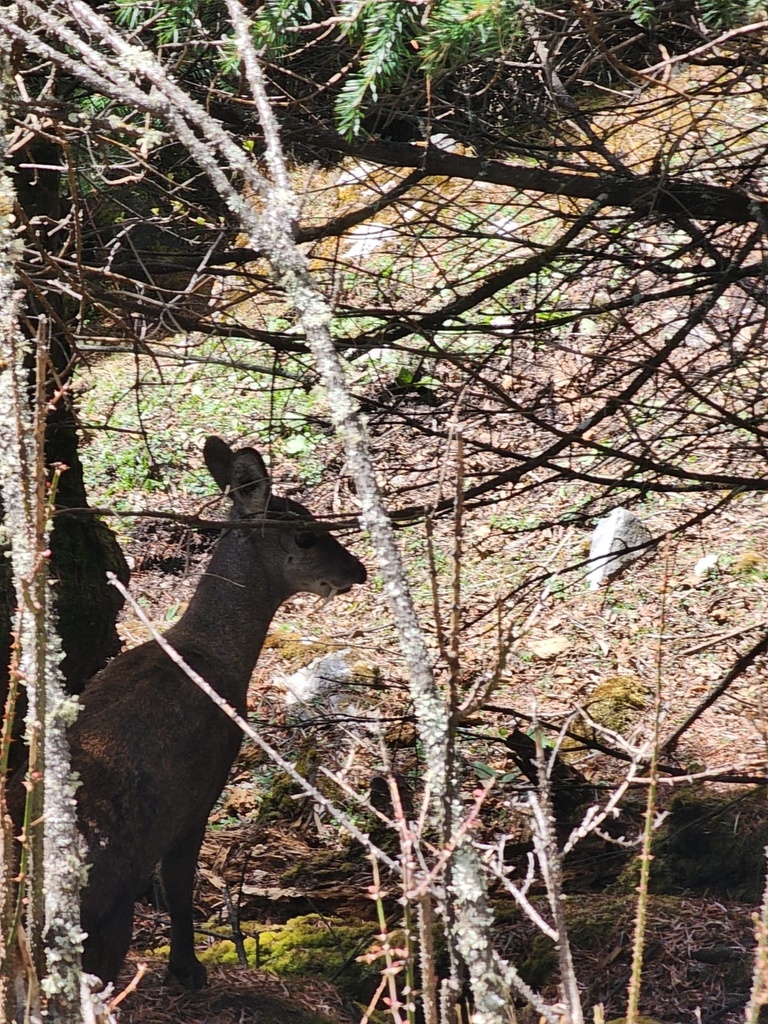
Photo: Steve Llewellyn · CC-BY (May be cropped or resized)
Moschus leucogaster
Basic stats
Diet
Leaves of trees and shrubs, chosen for high protein and low fibre
Habitat
High alpine environments above about 2,500m
Range
Eastern Himalaya of Nepal and India, possibly Bhutan and China
Litter size
1–2 young
The white-bellied or Himalayan musk deer is endemic to the eastern Himalaya, found from the Annapurna Himalaya and Kali Gandaki gorge eastwards in Nepal and India, and possibly in Bhutan and China. It was previously considered a subspecies of the alpine musk deer but was separated on skull proportions. Males carry tusks up to about 10 cm long and secrete musk from a gland in the abdomen (Wikipedia, general species account).
It lives in high alpine environments above about 2,500 m. It has a dense coat of coarse, air-filled hairs for insulation, well-developed dew claws and broad toes for steep slopes, and it bounds rather than runs. At night it comes out to feed in more open habitats, choosing leaves with high protein and low fibre. Fawns are spotted, and a female has one or two young at a time. Records from Sikkim and Arunachal Pradesh are likely this species or the black musk deer, but lack genetic confirmation (Wikipedia, general species account).
Quick answers
- What does the Himalayan Musk-deer eat?
- Leaves of trees and shrubs, chosen for high protein and low fibre
- What habitat does the Himalayan Musk-deer live in?
- High alpine environments above about 2,500m
- Where is the Himalayan Musk-deer found?
- Eastern Himalaya of Nepal and India, possibly Bhutan and China
- What is the litter size of the Himalayan Musk-deer?
- 1–2 young