
 Wildlife
of India
Lesser Florican
Cranes, Rails & Bustards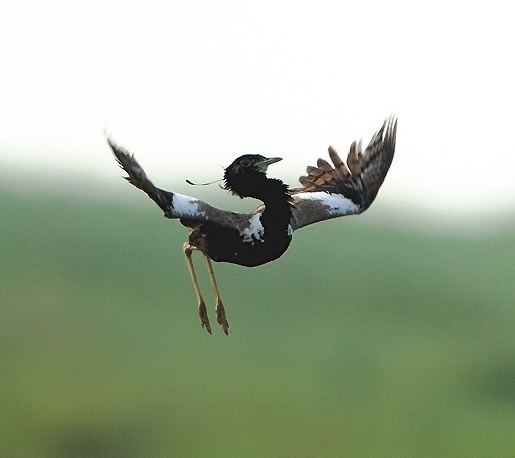
Photo: Sypheotides_indicus.jpg: Koshyk derivative work: Netzach · CC BY 2.0 (May be cropped or resized)
Sypheotides indicus
Basic stats
Diet
Omnivore
Habitat
Tall grassland
Range
Indian subcontinent; mainly north-western and central India in summer, more widely in winter
Clutch size
3–4 eggs
The lesser florican, also known as the likh or kharmore, is the smallest bustard and the only member of its genus. The male in breeding plumage has a striking black and white pattern, with a black head, neck and lower parts and distinctive ribbon-like head feathers, about 10 cm long, which arise behind the ear coverts, curve up and end in a spatulate tip. Females and non-breeding males are buff with black streaks. Young birds have a distinct U-shaped mark on the neck near the throat (Wikipedia, general species account).
It is endemic to the Indian subcontinent, where it lives in tall grassland and is best known for the leaping breeding displays of males in the monsoon. It is found mainly in north-western and central India in summer and more widely across India in winter, and was formerly more widespread but not in Sri Lanka. The nest is a shallow scrape in dense grass with three or four eggs, and females alone incubate and raise the chicks. It is threatened by hunting and habitat degradation. SoIB 2023 rates it a High conservation priority, with a Restricted range of about 7,700 km² (Wikipedia, general species account; SoIB 2023).
Quick answers
- What does the Lesser Florican eat?
- Omnivore
- What habitat does the Lesser Florican live in?
- Tall grassland
- Where is the Lesser Florican found?
- Indian subcontinent; mainly north-western and central India in summer, more widely in winter
- How many eggs does the Lesser Florican lay?
- 3–4 eggs