
 Wildlife
of India
Sarus Crane
Cranes, Rails & Bustards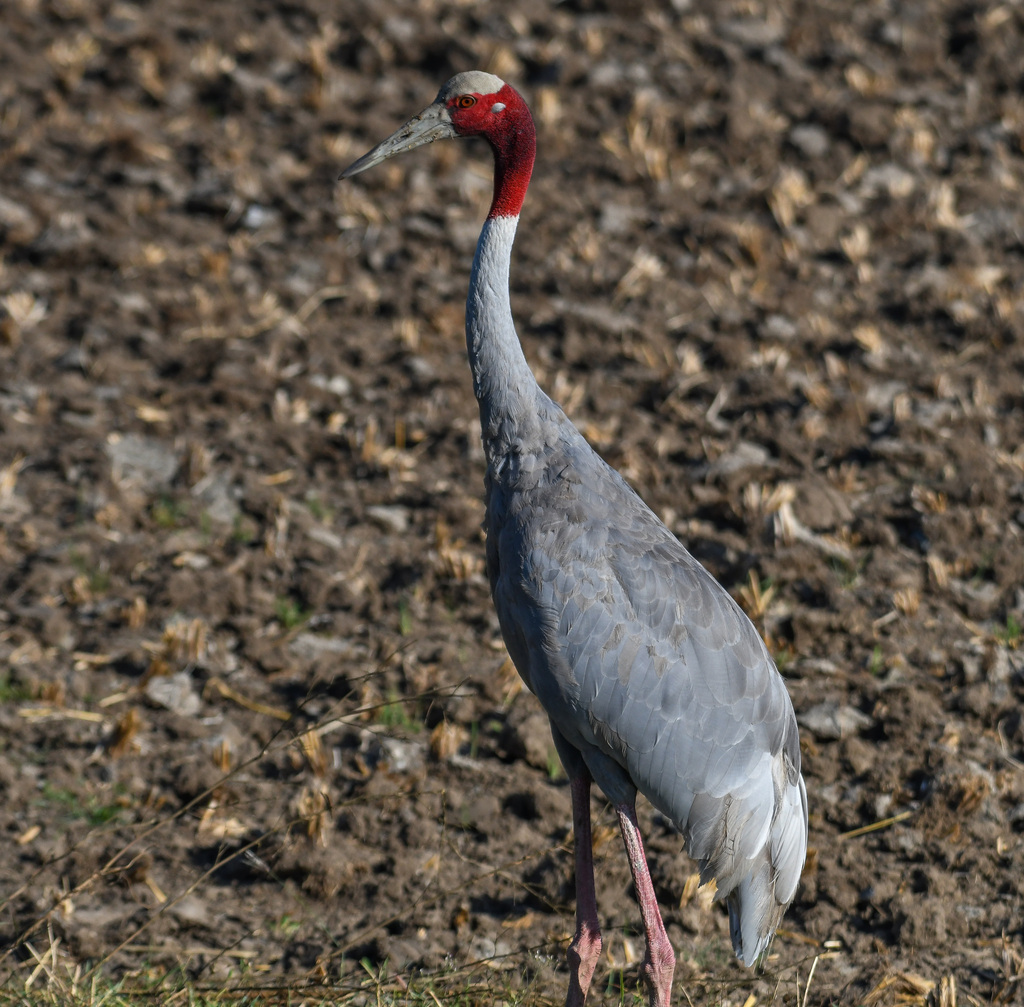
Photo: Rejoice Gassah · CC-BY (May be cropped or resized)
Antigone antigone
Basic stats
Diet
Roots, tubers, insects, crustaceans and small vertebrates
Habitat
Open wetlands and marshes
Range
Indian subcontinent, Southeast Asia and northern Australia
Size
Up to 1.8m tall
The sarus crane is the tallest of the flying birds, standing up to 1.8 m. It is easily told from other cranes in the region by its overall grey colour and contrasting red head and upper neck: the adult has grey wings and body, a bare red head, collar and nape, a greyish crown, and a long, greenish-grey, pointed bill. In flight the long neck is held straight and the black wing tips show, with the long pink legs trailing behind (Wikipedia, general species account).
It is a large, non-migratory crane of open wetlands, found in parts of the Indian subcontinent, Southeast Asia and northern Australia. In India it is a symbol of marital fidelity, believed to mate for life. It forages in marshes and shallow wetlands for roots, tubers, insects, crustaceans and small vertebrates, and breeds in the wet season, building an enormous island nest of reeds and grasses nearly two metres across; eggs are chalky white and weigh about 240 g. It is rare in West Bengal and Assam and no longer found in Bihar. SoIB 2023 rates it a High conservation priority, with a rapid long-term decline of about 75% and a current decline of over 5% a year (Wikipedia, general species account; SoIB 2023).
Quick answers
- What does the Sarus Crane eat?
- Roots, tubers, insects, crustaceans and small vertebrates
- What habitat does the Sarus Crane live in?
- Open wetlands and marshes
- Where is the Sarus Crane found?
- Indian subcontinent, Southeast Asia and northern Australia
- How big is the Sarus Crane?
- Up to 1.8m tall