
 Wildlife
of India
Nilgiri Laughingthrush
Babblers, Laughingthrushes & White-eyes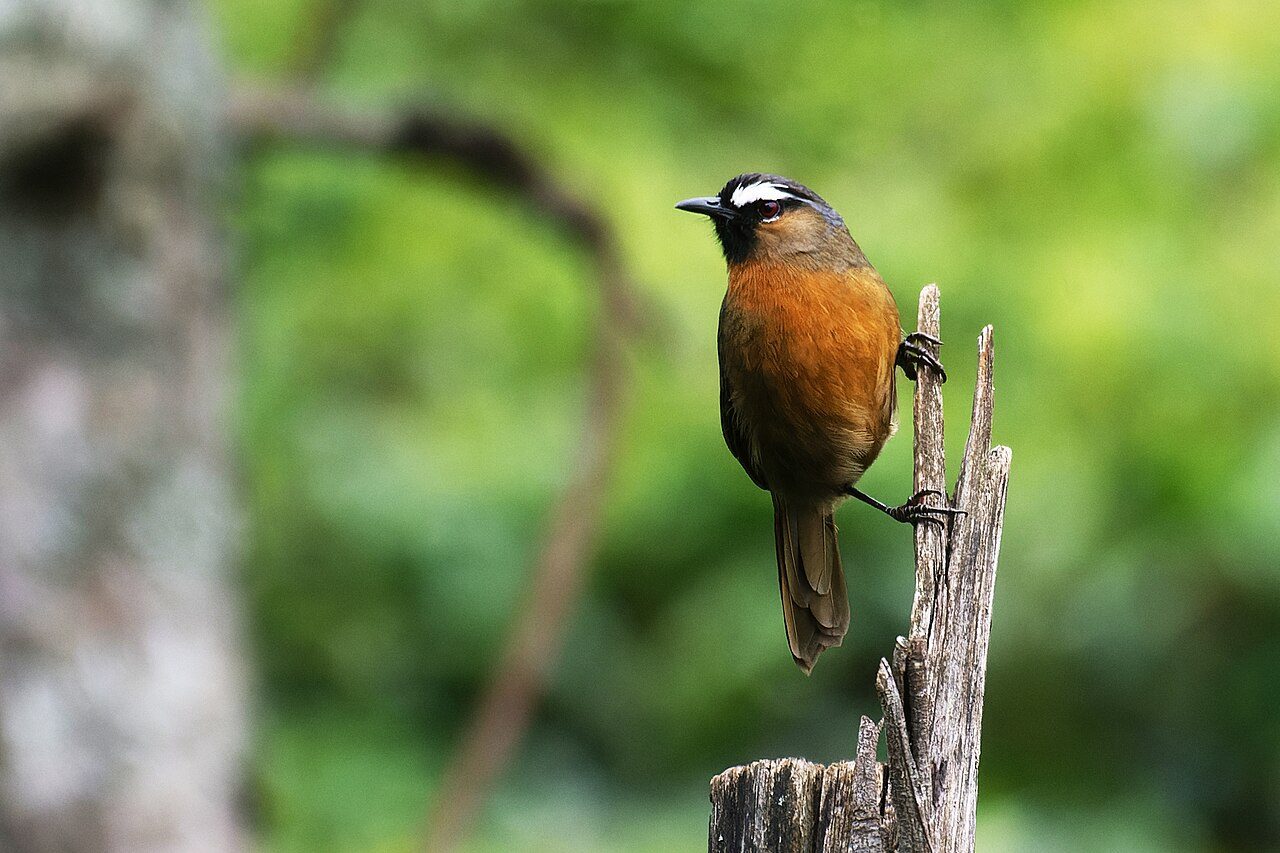
Photo: Shiv's fotografia · CC BY-SA 4.0 (May be cropped or resized)
Montecincla cachinnans
Basic stats
Diet
Invertebrates (SoIB guild)
Habitat
Dense forest patches on the Nilgiri and Wayanad ranges above 1,200m
Range
Endemic to the high-elevation Nilgiris and adjoining hill ranges in peninsular India
Clutch size
2 greenish-blue eggs with brown blotches and streaks
Size
About 24cm
The Nilgiri laughingthrush is a laughingthrush endemic to the high-elevation Nilgiris and adjoining hill ranges in peninsular India, about 24 cm long. It is unmistakable in plumage, with mostly rufous underparts, olive-brown upperparts, a slaty-brown crown, a prominent, jagged, broad white eyebrow margined with black, and a black throat, lores and streak behind the eye, though at a quick glance it can be mistaken for an Indian scimitar babbler. It lives in dense forest patches on the Nilgiri and Wayanad ranges above 1,200 m (Wikipedia, general species account).
It is easily detected by its loud series of nasal call notes but can be hard to spot inside dense vegetation. It nests from February to the beginning of June, both sexes building the nest, with a clutch of two eggs. In the past two subspecies were recognised, the nominate in the Nilgiris, earlier called the black-chinned or rufous-breasted laughingthrush, and jerdoni, now treated as the Banasura laughingthrush. SoIB 2023 treats it as a Western Ghats endemic and rates it a High conservation priority, with a Very Restricted range of about 4,940 km² and a decline of about 59% over the long term (Wikipedia, general species account; SoIB 2023).
Quick answers
- What does the Nilgiri Laughingthrush eat?
- Invertebrates (SoIB guild)
- What habitat does the Nilgiri Laughingthrush live in?
- Dense forest patches on the Nilgiri and Wayanad ranges above 1,200m
- Where is the Nilgiri Laughingthrush found?
- Endemic to the high-elevation Nilgiris and adjoining hill ranges in peninsular India
- How many eggs does the Nilgiri Laughingthrush lay?
- 2 greenish-blue eggs with brown blotches and streaks
- How big is the Nilgiri Laughingthrush?
- About 24cm