
 Wildlife
of India
Red-breasted Merganser
Ducks, Geese & Grebes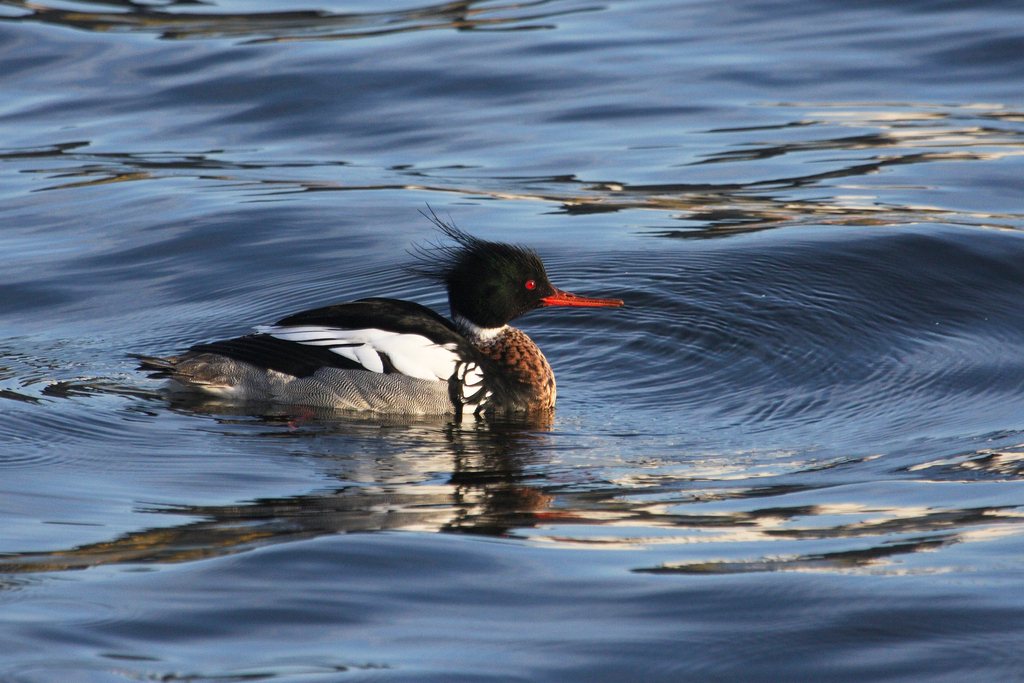
Photo: (c) Thomas Galewski, some rights reserved (CC BY) · CC-BY (May be cropped or resized)
Mergus serrator
Basic stats
Diet
Fish and other aquatic animals, caught by diving
Habitat
Breeds on lakes and rivers; winters mostly on coasts
Incubation period
28–35 days
Size
51–64cm; wingspan 66–74cm
Weight
Males 950–1,350g; females 800–1,100g
The red-breasted merganser is a duck native to much of the temperate to subarctic Northern Hemisphere, 51–64 cm long with a wingspan of 66–74 cm. Males weigh 950–1,350 g and females 800–1,100 g. It has a spiky crest and a long, thin red bill with serrated edges, which it uses to catch slippery fish while diving from the surface. The red breast is displayed only by males in breeding plumage (Wikipedia, general species account).
Individuals fly rapidly. They migrate each year from breeding sites on lakes and rivers to mostly coastal wintering areas, which makes this the species of its genus most often found on salt water. Incubation takes 28–35 days. Females, immatures and non-breeding males can be hard to tell from the common merganser. The cached account gives no detail specific to India. SoIB 2023 lists it as a winter migrant of wetlands that eats vertebrates, and does not assign a priority category (Wikipedia, general species account; SoIB 2023).
Quick answers
- What does the Red-breasted Merganser eat?
- Fish and other aquatic animals, caught by diving
- What habitat does the Red-breasted Merganser live in?
- Breeds on lakes and rivers; winters mostly on coasts
- How long are the eggs of the Red-breasted Merganser incubated?
- 28–35 days
- How big is the Red-breasted Merganser?
- 51–64cm; wingspan 66–74cm
- How much does the Red-breasted Merganser weigh?
- Males 950–1,350g; females 800–1,100g