
 Wildlife
of India
Tibetan Sandgrouse
Pigeons, Doves & Sandgrouse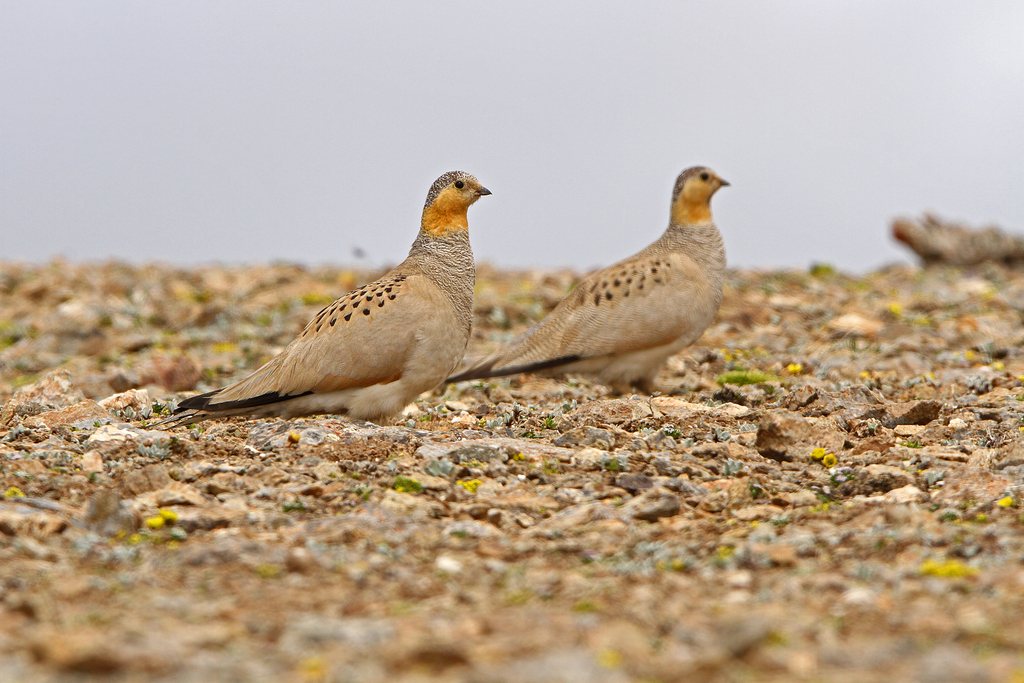
Photo: no rights reserved · CC0
Syrrhaptes tibetanus
Basic stats
Diet
Seeds, grass, buds and legumes
Habitat
Arid stony plateau and undulating semi-desert plains
Clutch size
3 pale brown elliptical eggs
Size
30–41cm
The Tibetan sandgrouse is a large sandgrouse, 30–41 cm long, with a small, pigeon-like head and neck on a sturdy, compact body. It has long pointed wings and a pin tail, an orange face, and a finely barred grey breast, neck and crown, with a white belly and black underwings; these last two distinguish it from Pallas's sandgrouse, whose range overlaps. Juveniles lack the tail pin, have narrower barring and less orange on the face (Wikipedia, general species account).
Birds forage in the morning and afternoon on undulating semi-desert plains, moving fast, and feed on seeds, grass, buds and legumes. They breed from May to June on the arid stony plateau and ridges, the nest usually near the top of a ridge on the leeward side, a ground scrape, often exposed but sometimes shielded by a stone or grass, holding three pale brown, cryptically marked eggs. SoIB 2023 lists it as a resident of alpine and cold desert that eats plants and seeds, and does not assign a priority category (Wikipedia, general species account; SoIB 2023).
Quick answers
- What does the Tibetan Sandgrouse eat?
- Seeds, grass, buds and legumes
- What habitat does the Tibetan Sandgrouse live in?
- Arid stony plateau and undulating semi-desert plains
- How many eggs does the Tibetan Sandgrouse lay?
- 3 pale brown elliptical eggs
- How big is the Tibetan Sandgrouse?
- 30–41cm