
 Wildlife
of India
Blyth's Tragopan
Pheasants, Partridges & Quails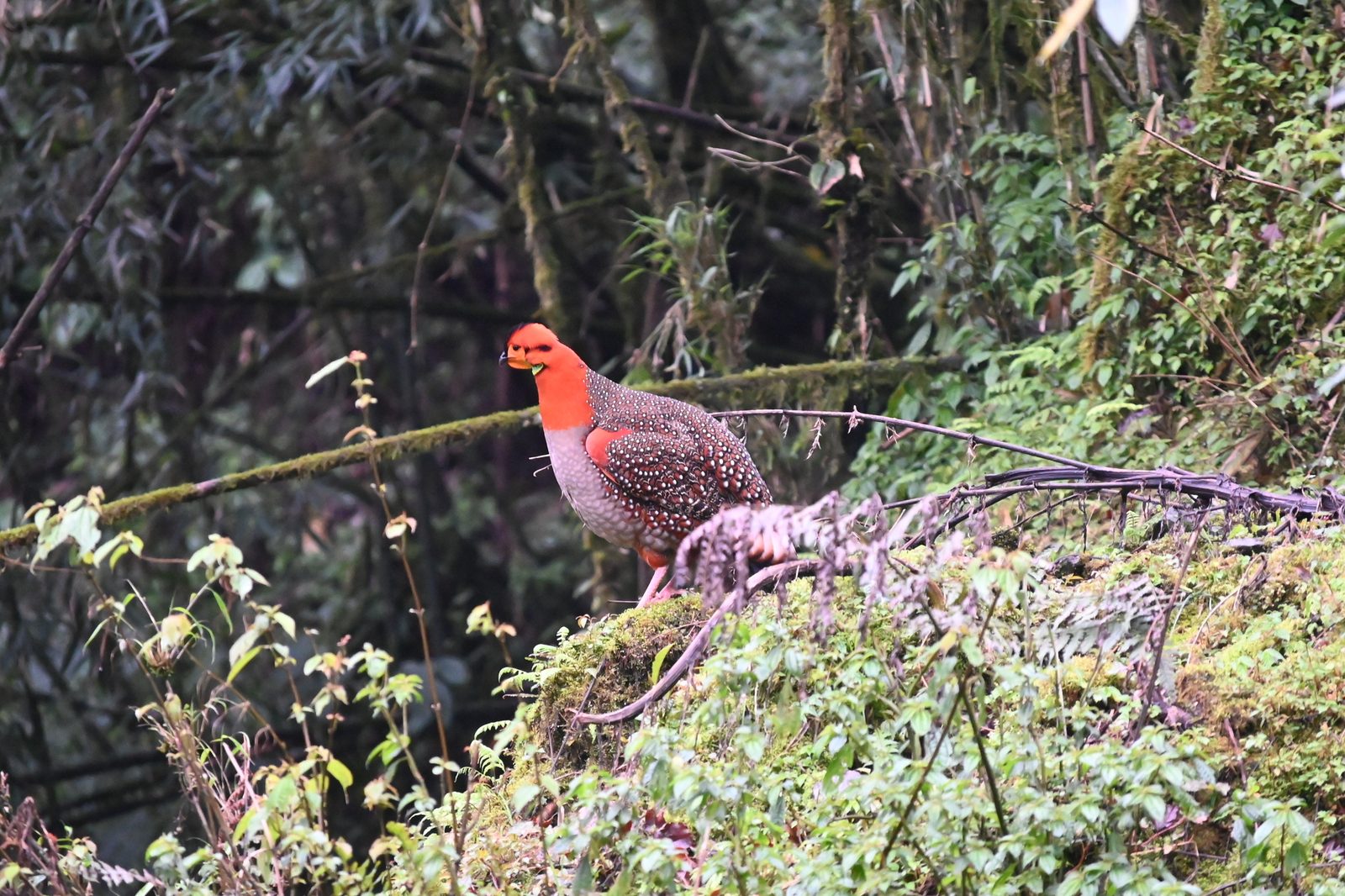
Photo: (c) Rohit, some rights reserved (CC BY-SA) · CC-BY-SA (May be cropped or resized)
Tragopan blythii
Basic stats
Habitat
Forest, moving up and down Himalayan slopes with the seasons
Range
Bhutan through north-east India and north Myanmar to south-east Tibet
Clutch size
2–5 eggs
Incubation period
About 28 days
Blyth's tragopan is named for Edward Blyth, curator of the Museum of the Asiatic Society of Bengal, and is the state bird of Nagaland. Like most pheasants the male is brightly coloured, recognised by a rusty red head, yellow facial skin, and small white dots, called ocelli, on his back. A black band extends from the bill base to the crown and another behind the eyes. Like other tragopans, males have two pale blue horns and a lappet that are displayed during courtship (Wikipedia, general species account).
It is found from Bhutan through north-east India and northern Myanmar to south-east Tibet, and may move up and down Himalayan slopes to find food and with seasonal temperature. Mating starts in April and continues into May, the nests being made of sticks lined with smaller vegetation such as grass. The female lays up to two to five eggs, incubated for about 28 days. SoIB 2023 treats it as an eastern Himalayan endemic, rates it a High conservation priority, and gives a Very Restricted range of about 6,900 km² (Wikipedia, general species account; SoIB 2023).
Quick answers
- What habitat does the Blyth's Tragopan live in?
- Forest, moving up and down Himalayan slopes with the seasons
- Where is the Blyth's Tragopan found?
- Bhutan through north-east India and north Myanmar to south-east Tibet
- How many eggs does the Blyth's Tragopan lay?
- 2–5 eggs
- How long are the eggs of the Blyth's Tragopan incubated?
- About 28 days