
 Wildlife
of India
Western Tragopan
Pheasants, Partridges & Quails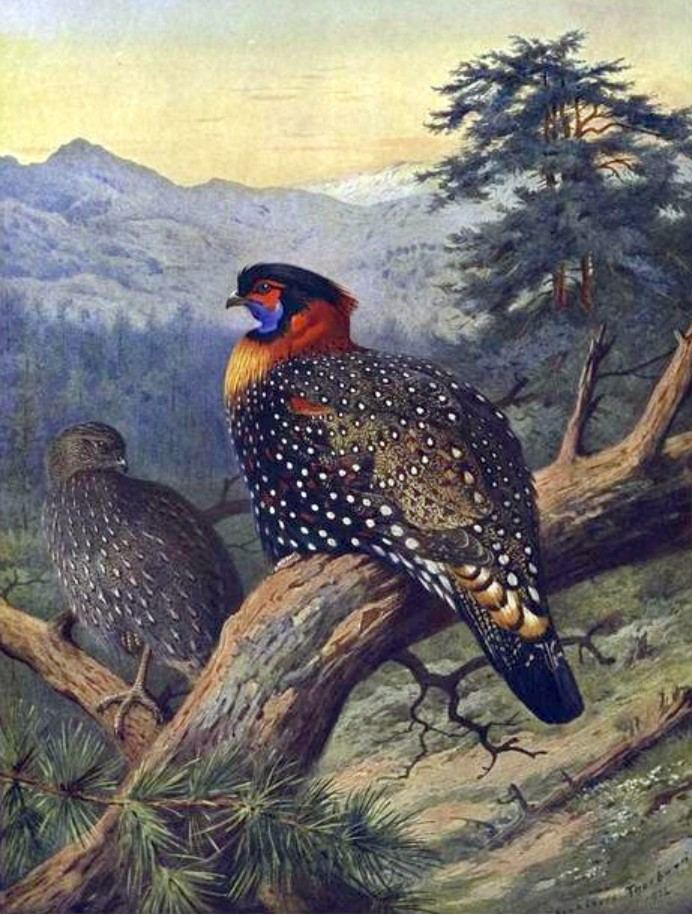
Photo: Archibald Thorburn · Public domain
Tragopan melanocephalus
Basic stats
Diet
Leaves, shoots and seeds; also insects and other invertebrates
Habitat
Forest at about 1,750–3,600m, higher in summer
Range
Western Himalaya from northern Pakistan to Uttarakhand
Size
Males 55–60cm; females 48–50cm
Weight
Males 1.8–2.2kg; females 1.25–1.4kg
The western tragopan is a medium-sized, brightly plumed pheasant of the western Himalaya, from north-eastern Khyber Pakhtunkhwa in Pakistan to Uttarakhand in India. The male is very dark, grey and black with numerous white spots, each bordered with black, and deep crimson patches on the sides and back of the neck. The throat is bare with blue skin, the facial skin is red, and there is a small black crest. Males weigh 1.8–2.2 kg and are 55–60 cm long; females weigh 1.25–1.4 kg and are 48–50 cm (Wikipedia, general species account).
It lives at about 1,750 to 3,600 m, going higher in summer. It is mostly arboreal but feeds on the ground, taking mostly leaves, shoots and seeds and also insects and other invertebrates, and like most pheasants roosts in trees singly or in pairs except when nesting. In display it gives a loud two-note ringing call, wou-weee, repeated every second for long periods. The breeding season is May and June. SoIB 2023 treats it as a western Himalayan endemic, rates it a High conservation priority, and gives a Very Restricted range of about 5,400 km² (Wikipedia, general species account; SoIB 2023).
Quick answers
- What does the Western Tragopan eat?
- Leaves, shoots and seeds; also insects and other invertebrates
- What habitat does the Western Tragopan live in?
- Forest at about 1,750–3,600m, higher in summer
- Where is the Western Tragopan found?
- Western Himalaya from northern Pakistan to Uttarakhand
- How big is the Western Tragopan?
- Males 55–60cm; females 48–50cm
- How much does the Western Tragopan weigh?
- Males 1.8–2.2kg; females 1.25–1.4kg