
 Wildlife
of India
Great Indian Bustard
Cranes, Rails & Bustards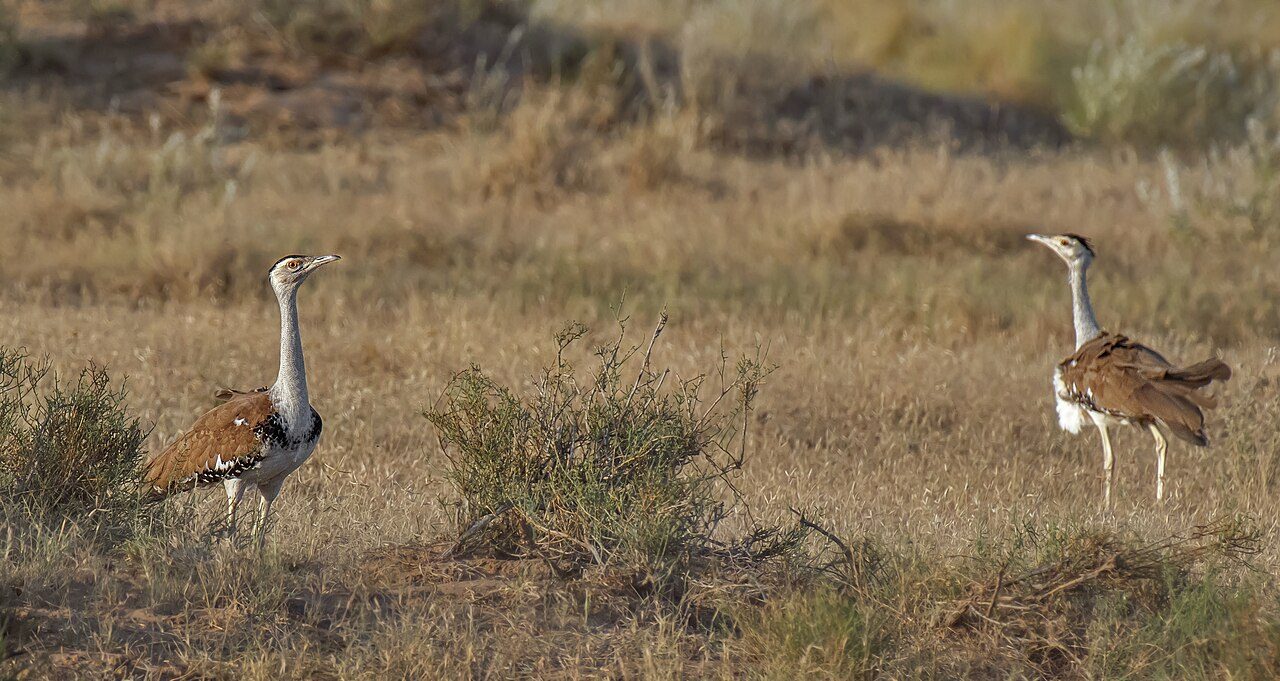
Photo: SVKMBFLY · CC BY-SA 4.0 (May be cropped or resized)
Ardeotis nigriceps
Basic stats
Diet
Omnivore: grass seeds, berries (Ziziphus and Eruca), rodents, reptiles and Indian spiny-tailed lizards
Habitat
Dry grassland and shrubland
Range
Central and western India and eastern Pakistan; Indian subcontinent endemic
Clutch size
1 egg
Size
About 1m tall
The great Indian bustard is a large bird with a horizontal body and long bare legs, among the heaviest of the flying birds, standing about 1 m tall. It is unmistakable, with a black cap contrasting with the pale head and neck, a brownish body with a black patch spotted in white, and a tail held cocked over the body. The male is deep sandy buff, with a black breast band in the breeding season, and displaying males puff up a black crest. Males have a well-developed gular pouch that helps produce a resonant, booming call that carries nearly 500 m (Wikipedia, general species account).
It was once common on the dry grasslands and shrublands of India, but only about 150 individuals were estimated to survive as of 2018, down from about 250 in 2011. The main breeding areas are in central and western India and eastern Pakistan. It is protected under India's Wild Life (Protection) Act, 1972. It is omnivorous, taking grass seeds, berries, rodents and reptiles, and in Rajasthan it hunts Indian spiny-tailed lizards. The female lays a single egg in an unlined scrape and alone incubates and cares for the young. SoIB 2023 rates it a High conservation priority, with a Restricted range of about 29,000 km² (Wikipedia, general species account; SoIB 2023).
Quick answers
- What does the Great Indian Bustard eat?
- Omnivore: grass seeds, berries (Ziziphus and Eruca), rodents, reptiles and Indian spiny-tailed lizards
- What habitat does the Great Indian Bustard live in?
- Dry grassland and shrubland
- Where is the Great Indian Bustard found?
- Central and western India and eastern Pakistan; Indian subcontinent endemic
- How many eggs does the Great Indian Bustard lay?
- 1 egg
- How big is the Great Indian Bustard?
- About 1m tall