
 Wildlife
of India
Himalayan Monal
Pheasants, Partridges & Quails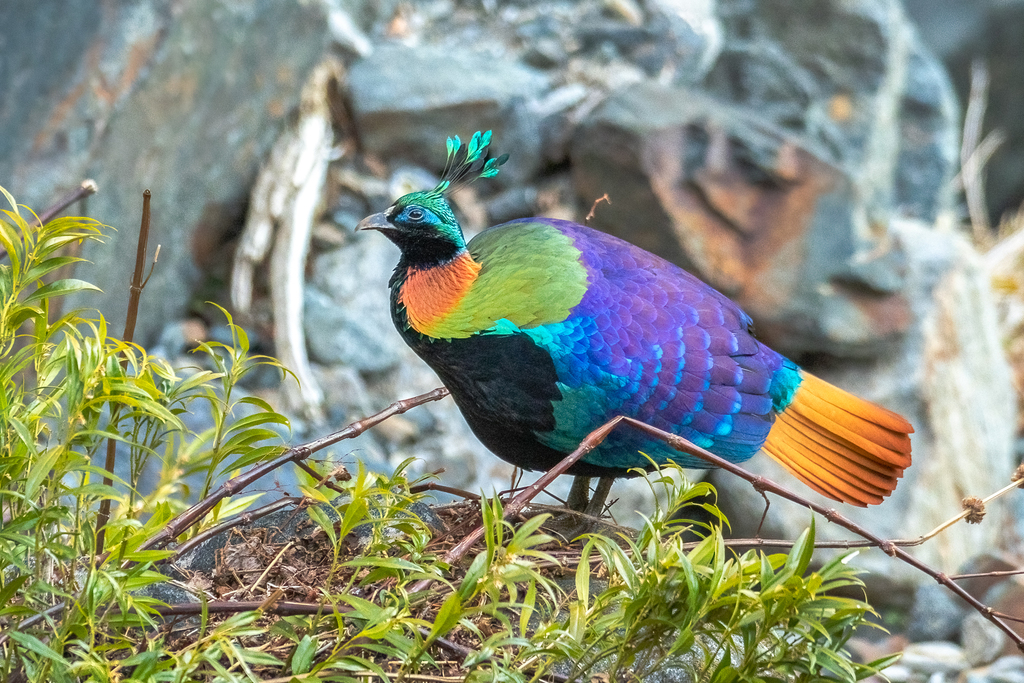
Photo: egorbirder · CC-BY (May be cropped or resized)
Lophophorus impejanus
Basic stats
Diet
Tubers, nuts, tender leaves and shoots, insects and other invertebrates
Habitat
Upper temperate oak and conifer forest with open grassy slopes, cliffs and alpine meadows, about 2,400–4,500m
Range
The Himalaya, from Jammu and Kashmir to Arunachal Pradesh
Size
61–76cm
Weight
1.4–2.3kg
The Himalayan monal, or Impeyan monal, is a large pheasant. The adult male is multicoloured all over, with a long metallic green crest, coppery feathers on the back and neck, a prominent white rump that shows best in flight and a plain rufous tail that darkens towards the tip. The female is much more subdued, with a prominent white throat patch, a white stripe on the tail and white undertail feathers barred with black and red. First-year males look like females but are larger. It is named after Lady Mary Impey, wife of a chief justice of Bengal (Wikipedia, general species account).
The monal lives high in the mountains, in oak and conifer forest broken by grassy slopes, cliffs and alpine meadows. It feeds mainly on plant matter, eating tubers, nuts, tender leaves and shoots, and adds insects and other invertebrates; in winter it digs through snow to reach food. Across its range the main threats are poaching, since the male's crest is prized as a status symbol, and disturbance, including hydroelectric development in the western Himalaya (Wikipedia, general species account).
In India the monal is found along the whole Himalayan region and is restricted to the Himalaya. The State of India's Birds 2023 rates it a Low conservation priority, with a moderate range of about 64,000 km², but there are too few long-term records to estimate its long-term trend, and its current trend is inconclusive (SoIB 2023).
Quick answers
- What does the Himalayan Monal eat?
- Tubers, nuts, tender leaves and shoots, insects and other invertebrates
- What habitat does the Himalayan Monal live in?
- Upper temperate oak and conifer forest with open grassy slopes, cliffs and alpine meadows, about 2,400–4,500m
- Where is the Himalayan Monal found?
- The Himalaya, from Jammu and Kashmir to Arunachal Pradesh
- How big is the Himalayan Monal?
- 61–76cm
- How much does the Himalayan Monal weigh?
- 1.4–2.3kg