
 Wildlife
of India
Hoplobatrachus tigerinus
True Frogs, Night Frogs & Allies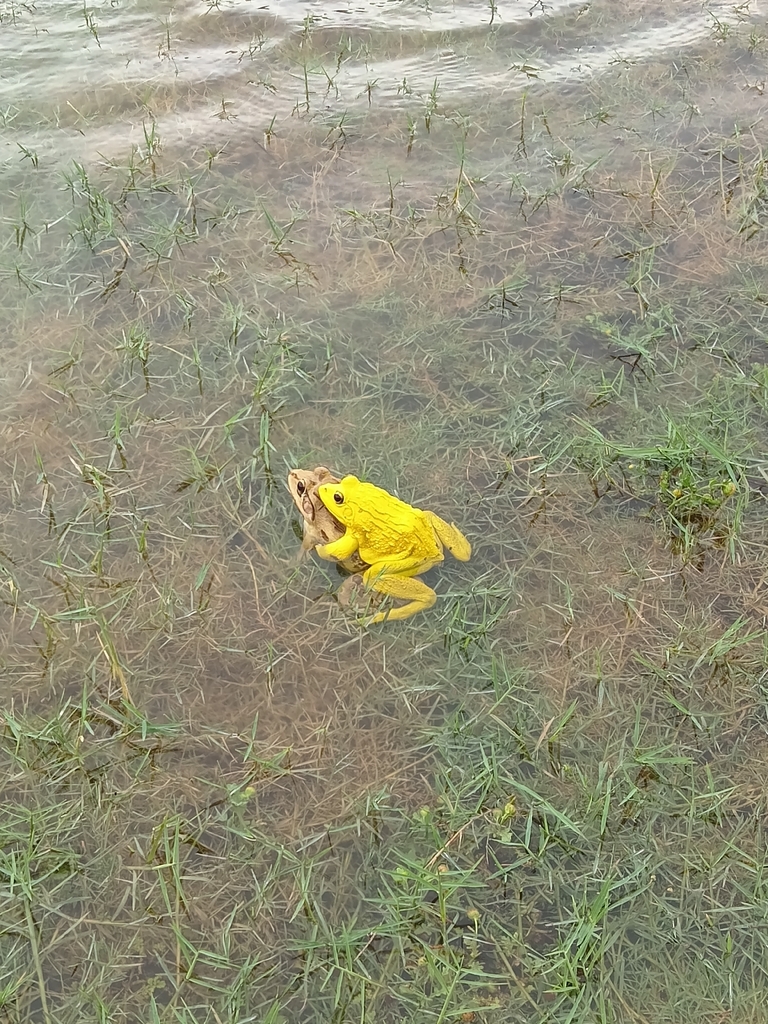
Photo: (c) SreyaP, some rights reserved (CC BY-SA) · CC-BY-SA (May be cropped or resized)
Hoplobatrachus tigerinus
Basic stats
Habitat
Freshwater wetlands, especially paddy fields; not forest or coasts
Range
Native across mainland India; introduced to the Andaman Islands
Size
Up to 17cm
The Indian bullfrog is a large frog, growing up to 17 cm long. It is usually green or brown with dark spots, often with a yellow stripe down the middle of the back, though colour and size vary a lot between populations. In the breeding season males turn bright yellow and have a pair of blue vocal sacs at the sides of the throat. The hands are unwebbed but the feet are fully webbed. In males the eardrum is larger than the eye; females are larger and heavier (Wikipedia, general species account).
The Indian bullfrog lives in freshwater wetlands, especially paddy fields, and is rarely found in forest or on the coast. It is a predator large enough to eat other frogs, reptiles and centipedes, and even its tadpoles are carnivorous, eating the tadpoles of other species. Outside its native range it has become an aggressive invader: it was introduced to Madagascar as food and has become a pest there, and it is also established in the Maldives (Wikipedia, general species account).
Native across mainland India, the bullfrog has become a serious invasive species in the Andaman Islands, where it arrived around 2000 and has since reached six of the eight inhabited islands. In experiments at the Andaman Nicobar Environment Team field station, bullfrog tadpoles ate every native tadpole, of Chakrapani's narrow-mouthed frog and the Andaman tree frog, within three weeks, and within the first week in 83% of the pools; without bullfrogs, three in four native tadpoles survived to become frogs. The researchers warn that it could spread to the Nicobar Islands (Mohanty and Measey 2019, as reported by Mongabay India).
Quick answers
- What habitat does the Hoplobatrachus tigerinus live in?
- Freshwater wetlands, especially paddy fields; not forest or coasts
- Where is the Hoplobatrachus tigerinus found?
- Native across mainland India; introduced to the Andaman Islands
- How big is the Hoplobatrachus tigerinus?
- Up to 17cm