
 Wildlife
of India
Indian Chameleon
Chameleons & Other Lizards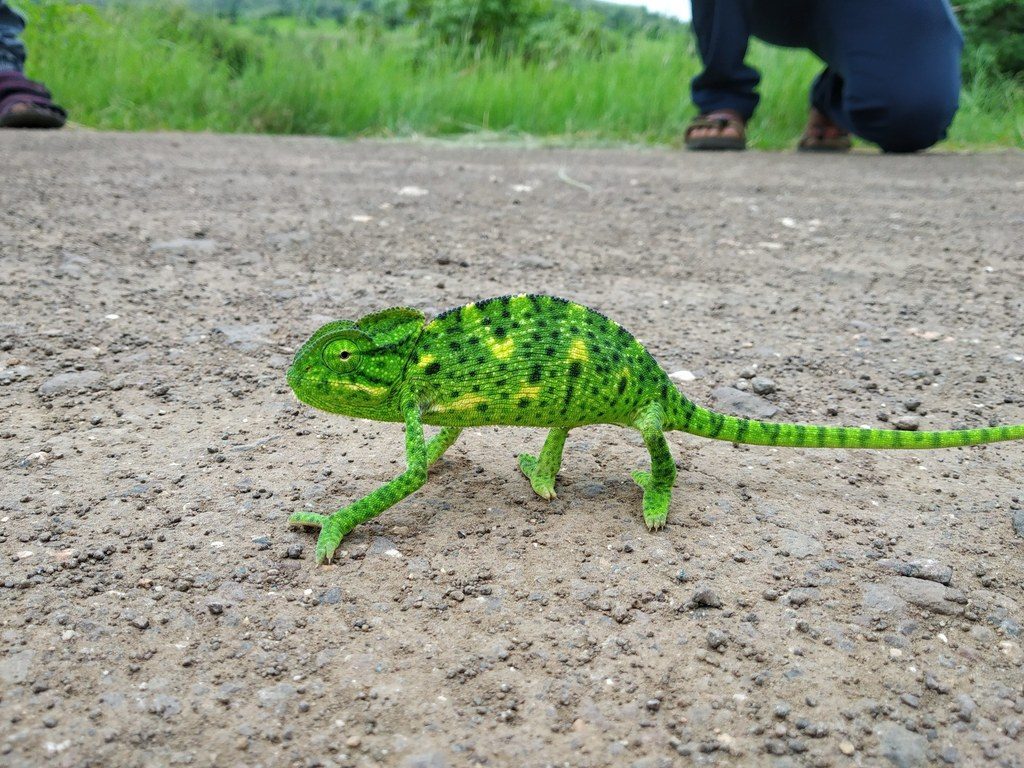
Photo: S.MORE · CC0 1.0
Chamaeleo zeylanicus
Basic stats
Diet
Insects
Habitat
Mostly arboreal, in trees and bushes
Range
India south of the Ganga, including Gujarat, Maharashtra, Madhya Pradesh, Telangana, Tamil Nadu and Kerala; also Sri Lanka and southeastern Pakistan
Size
Snout to vent up to about 18cm, plus a tail of about 20cm
The Indian chameleon is South Asia's only chameleon. It has a flattened body, a very short neck and a bony casque on the head that rises steeply at the back into a strong curved crest. The large eyes are covered by thick, granular lids with only a small opening for the pupil, and each moves independently of the other. Its feet are split into two opposing bundles of toes that grip like tongs, and its long tail is prehensile. It has no external ear. Its colour changes are mainly signals to other chameleons rather than a way of matching the background (Wikipedia, general species account).
It moves slowly with a bobbing, swaying gait that mimics branches moving in the wind, and spends most of its time in trees and bushes. It catches insects with an extremely long, sticky tongue that it uses to catch insects from several feet away. Its range is widely separated from all other chameleons, which live in Africa, the islands near it, southern Europe and Arabia, and genetic evidence suggests its ancestors reached India from Arabia across the sea in the mid-Miocene (Wikipedia, general species account).
In India the chameleon is found across much of the peninsula south of the Ganga plains. The Reptile Database lists records from Gujarat, Maharashtra, Madhya Pradesh, Telangana, Tamil Nadu, Kerala and Haryana, as well as Sri Lanka and Pakistan (Reptile Database, via Catalogue of Life). It is the only chameleon in India, so any chameleon seen in the country is this species, and its range stops at the Ganga plains in the north.
Quick answers
- What does the Indian Chameleon eat?
- Insects
- What habitat does the Indian Chameleon live in?
- Mostly arboreal, in trees and bushes
- Where is the Indian Chameleon found?
- India south of the Ganga, including Gujarat, Maharashtra, Madhya Pradesh, Telangana, Tamil Nadu and Kerala; also Sri Lanka and southeastern Pakistan
- How big is the Indian Chameleon?
- Snout to vent up to about 18cm, plus a tail of about 20cm