
 Wildlife
of India
Olive Ridley Sea Turtle
Sea Turtles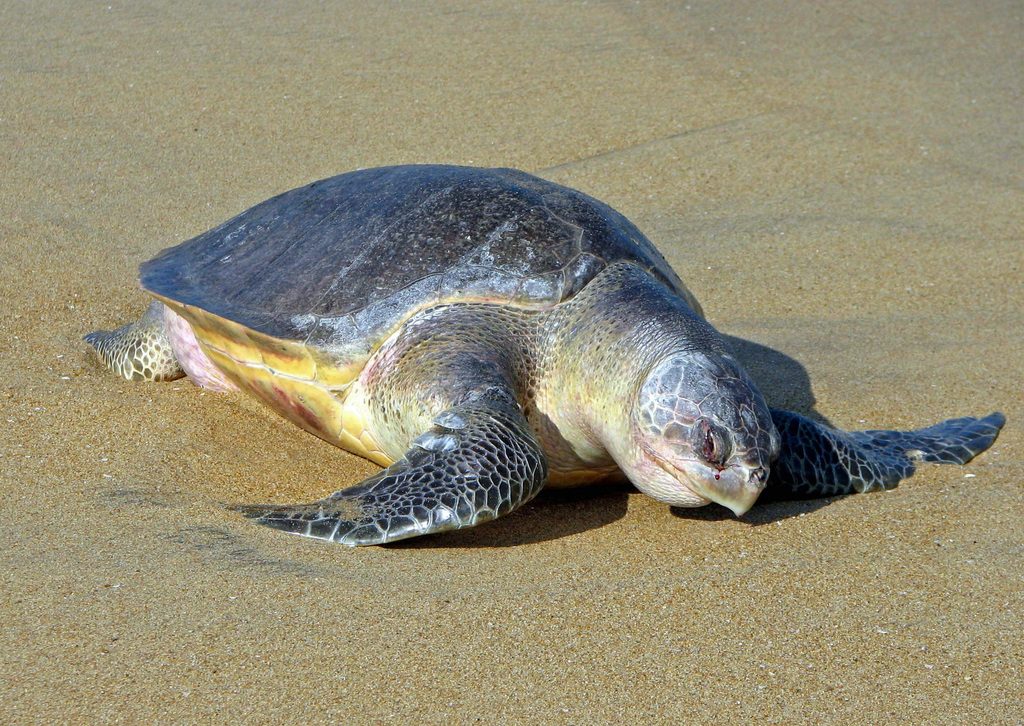
Photo: Bernard Gagnon · CC BY-SA 4.0 (May be cropped or resized)
Lepidochelys olivacea
Basic stats
Diet
Mainly carnivorous: crabs, shrimps, snails, bivalves, sea urchins, tunicates and jellyfish
Habitat
Warm and tropical seas; nests on sandy beaches
Range
Mainly the Pacific and Indian Oceans; also the warm Atlantic
Clutch size
About 105–116 eggs on average (30–168)
Incubation period
Usually 45–51 days
Size
Shell about 61cm long
Weight
Rarely over 50kg
The olive ridley is the second-smallest and the most abundant of the world's sea turtles. It takes its name from its olive-coloured shell, which is rounded and heart-shaped, flattened on top and about 61 cm long. It has a medium-sized, broad head that looks triangular from above and paddle-like front flippers with two claws each. Males and females are the same size, but males have a longer, thicker tail and hooked claws on the front flippers, and a longer, more tapered shell. It and the related Kemp's ridley are best known for their arribadas, synchronised mass nestings (Wikipedia, general species account).
Across its range the olive ridley is mainly carnivorous, eating crabs, shrimps, snails, bivalves, sea urchins, tunicates and jellyfish. Females return to nest on the beach where they hatched and lay their eggs in conical nests dug in the sand. Most nest alone, but in an arribada huge numbers come ashore on the same beach within a few nights. Eggs hatch after about 45 to 51 days, and the incubation temperature decides the sex of the hatchlings (Wikipedia, general species account).
Odisha's coast holds some of the world's most important olive ridley rookeries. In February 2025, nearly 6.98 lakh (about 698,000) turtles came ashore on the 5-km nesting beach at the Rushikulya river mouth over ten days, beating the previous record of 6.3 lakh set in 2023. Scientists from the Dakshin Foundation and the Indian Institute of Science, who have monitored the site since 2007, called it one of the biggest arribadas of the last 20 years (Odisha Forest Department, as reported by The Wire 2025). Gahirmatha, farther north on the Odisha coast, is another major mass-nesting site.
Quick answers
- What does the Olive Ridley Sea Turtle eat?
- Mainly carnivorous: crabs, shrimps, snails, bivalves, sea urchins, tunicates and jellyfish
- What habitat does the Olive Ridley Sea Turtle live in?
- Warm and tropical seas; nests on sandy beaches
- Where is the Olive Ridley Sea Turtle found?
- Mainly the Pacific and Indian Oceans; also the warm Atlantic
- How many eggs does the Olive Ridley Sea Turtle lay?
- About 105–116 eggs on average (30–168)
- How long are the eggs of the Olive Ridley Sea Turtle incubated?
- Usually 45–51 days
- How big is the Olive Ridley Sea Turtle?
- Shell about 61cm long
- How much does the Olive Ridley Sea Turtle weigh?
- Rarely over 50kg