
 Wildlife
of India
Saltwater Crocodile
Crocodiles & Gharial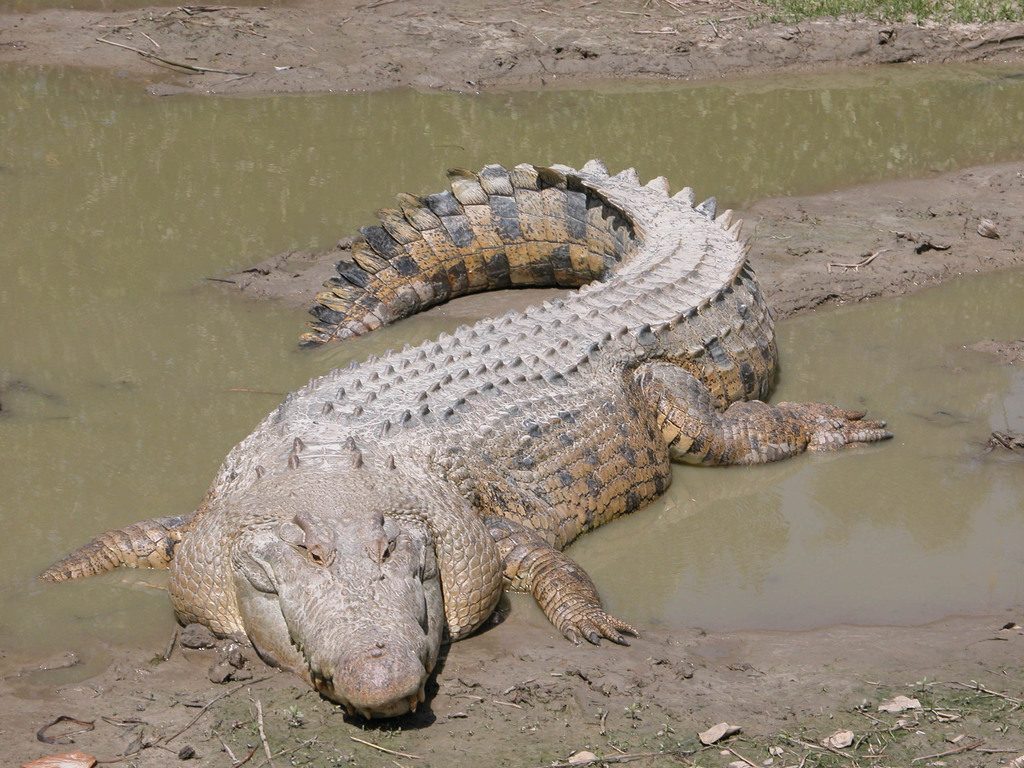
Photo: Obtained from Molly Ebersold of the St. Augustine Alligator Farm · Public Domain
Crocodylus porosus
Basic stats
Diet
Almost any animal that enters its territory: fish, crustaceans, amphibians, reptiles, birds and mammals
Habitat
Saltwater habitats, brackish wetlands and freshwater rivers
Range
East coast of India, including Bhitarkanika in Odisha
Size
Males about 6m, rarely over 6.3m; females rarely over 3m
Weight
Males 1,000–1,500kg
The saltwater crocodile, also called the estuarine crocodile, is the largest living reptile. It lives in saltwater habitats, brackish wetlands and freshwater rivers from the east coast of India across Southeast Asia to northern Australia and Micronesia. Males can reach 1,000 to 1,500 kg and about 6 m in length, rarely more than 6.3 m, while females rarely grow beyond 3 m, so a big male is far larger than any female (Wikipedia, general species account).
It is a large, opportunistic apex predator that ambushes most of its prey and then drowns it or swallows it whole. It takes almost any animal that enters its territory, including sharks, other fish, crustaceans, amphibians, reptiles, birds and mammals. It was hunted for its skin throughout its range until the 1970s, and it is regarded as dangerous to people (Wikipedia, general species account).
Bhitarkanika National Park in Odisha holds India's best-known saltwater crocodile population. Its annual census in January 2025, using daytime counts of large animals, torchlight counts of small ones at night and time-stamped video, recorded 1,826 crocodiles, 15 more than in 2024, including 18 albino individuals. About 608 of them are big enough to be a danger to people, and the park stopped its captive breeding and rearing programme in 2024 because the population had reached saturation (Odisha Forest Department, as reported by Down To Earth 2025).
Quick answers
- What does the Saltwater Crocodile eat?
- Almost any animal that enters its territory: fish, crustaceans, amphibians, reptiles, birds and mammals
- What habitat does the Saltwater Crocodile live in?
- Saltwater habitats, brackish wetlands and freshwater rivers
- Where is the Saltwater Crocodile found?
- East coast of India, including Bhitarkanika in Odisha
- How big is the Saltwater Crocodile?
- Males about 6m, rarely over 6.3m; females rarely over 3m
- How much does the Saltwater Crocodile weigh?
- Males 1,000–1,500kg