
 Wildlife
of India
Black-breasted Weaver
Finches, Sparrows & Buntings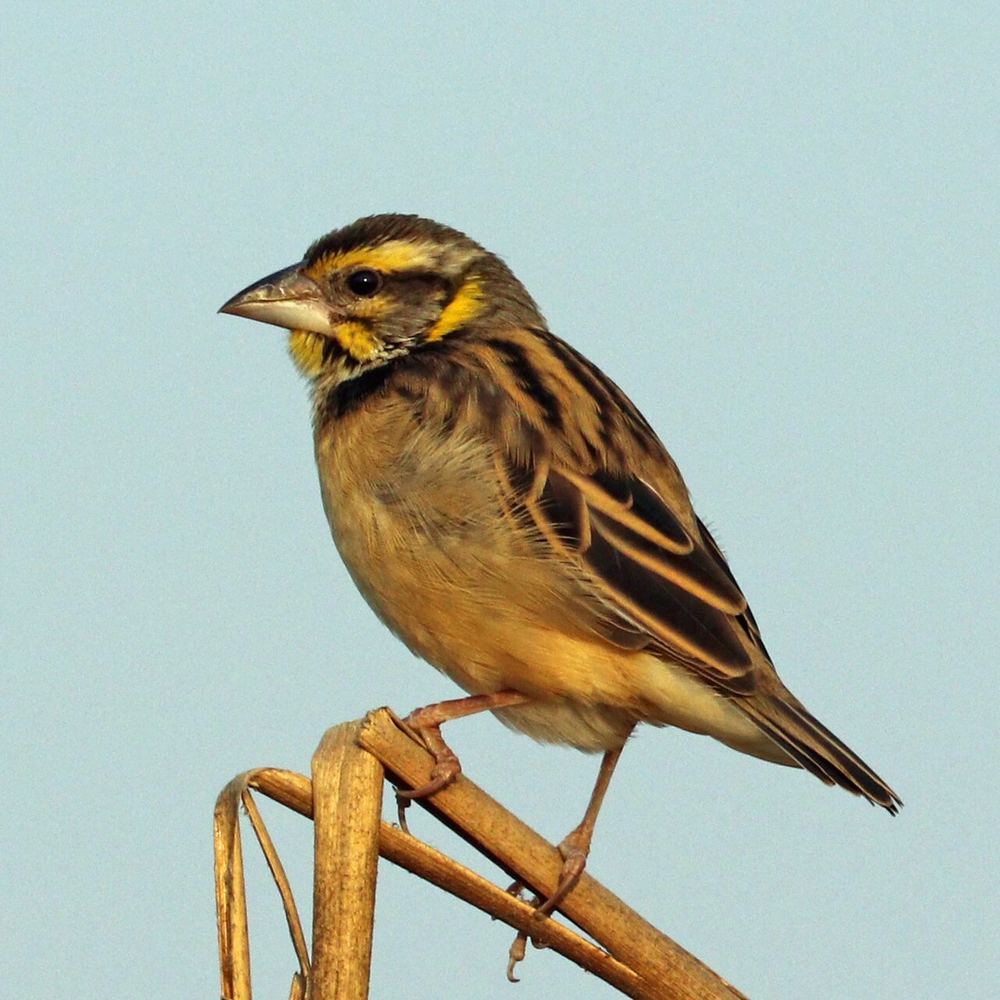
Photo: Charles J. Sharp · CC BY-SA 4.0 (May be cropped or resized)
Ploceus benghalensis
Basic stats
Diet
Plants and seeds (SoIB guild)
Habitat
Wetland; enclosed nests of reeds and mud in scattered groups of 4–5, sometimes larger colonies
Range
Northern river plains of the Indian subcontinent, with small populations in the peninsular region
Clutch size
3–4 white eggs
Size
About 15cm
The black-breasted, or Bengal, weaver, also known as the black-throated weaver, is a sparrow-sized weaver about 15 cm long, resident in the northern river plains of the Indian subcontinent with small populations in the peninsular region. The male in breeding plumage has a brilliant golden-yellow crown and a variable amount of black on the head and breast: some males have an entirely black head, apart from the yellow crown, and breast, while others have a whitish throat or an entirely buffy-white face with a black band separating it from the fulvous-white underparts. In the non-breeding male and the female the crown is brown like the rest of the upperparts and the black pectoral band is less developed (Wikipedia, general species account).
Like other weavers, the males build an enclosed nest from reeds and mud, and visiting females choose a mate at least partly on nest quality; once the female accepts and permits copulation, he quickly completes the nest and she lays inside, while he immediately starts a second nest nearby to attract other females, occasionally a third or very rarely a fourth. The entrance tube is somewhat shorter than the baya weaver's, and the clutch is three or four white eggs. Breeding takes place between June and September. SoIB 2023 treats it as endemic to the Indian subcontinent and rates it a Low conservation priority, with a Large range of about 375,000 km² and stable trends (Wikipedia, general species account; SoIB 2023).
Quick answers
- What does the Black-breasted Weaver eat?
- Plants and seeds (SoIB guild)
- What habitat does the Black-breasted Weaver live in?
- Wetland; enclosed nests of reeds and mud in scattered groups of 4–5, sometimes larger colonies
- Where is the Black-breasted Weaver found?
- Northern river plains of the Indian subcontinent, with small populations in the peninsular region
- How many eggs does the Black-breasted Weaver lay?
- 3–4 white eggs
- How big is the Black-breasted Weaver?
- About 15cm